Heat Transfer
Questions for Short Answer
1. The heat current is written as ΔQ/Δt. Why don't we write dQ/dt?
Answer: In dQ/dt, dQ is the change corresponding to dt, which is an infinitesimal time; that means Δt →0. It means Δt is not zero but very, very near to zero, as near as you can go. Obviously, you can not measure dt. So, to define the heat current, a very small but measurable time Δt is taken, the corresponding flow of heat ΔQ is measured, and the heat current is defined as ΔQ/Δt.
2. Does a body at 20°C radiate in a room, where the room temperature is 30°C? If yes, why does its temperature not fall further?
Answer: Yes, because all bodies radiate thermal radiation at all temperatures.
The temperature of the body does not fall further because simultaneously it absorbs a part of the heat radiation falling on it from the surrounding bodies which are at a higher temperature.
3. Why does blowing over a spoonful of hot tea cool it? Does evaporation play a role? Does radiation play a role?
Answer: Yes, both evaporation and radiation play a role. While blowing increases the evaporation, the evaporation takes heat energy from the liquid itself. So it cools faster.
Radiation plays a role but does not depend on blowing. Here, in a spoon, the area of the liquid is comparatively greater compared to the volume of the liquid. The radiation is directly proportional to the area.
Together, these phenomena cool the tea in the spoon.
4. On a hot summer day, we want to cool our room by opening the refrigerator door and closing all the windows and doors. Will the process work?
Answer: A refrigerator does not cool inside directly using electric current, but it uses a compressor to bring out the heat from inside, and this heat is radiated into the room using radiators on the back of the refrigerator.
Thus, closing the doors and windows and opening the door of the refrigerator will not cool the room because the heat taken out from inside the refrigerator is still in the room. Also, all of the electric energy is not utilized, so this part will add to the temperature of the room.
5. On a cold winter night, you are asked to sit on a chair. Would you like to choose a metal chair or a wooden chair? Both are kept in the same lawn and are at the same temperature.
Answer: A wooden chair will be selected because its thermal conductivity is much less than that of a metal chair. The wooden chair will allow very little heat from our body to pass through it, and very soon its contact area will be equal to the body temperature, and we will not feel it cold.
6. Two identical metal balls, one at T₁ =300 K and the other at T₂ = 600 K, are kept at a distance of 1 m in a vacuum. Will the temperature equalize by radiation? Will the rate of heat gained by the colder sphere be proportional to T₂⁴-T₁⁴ as may be expected from Stefan's law?
Answer: Both of the metal balls will radiate heat energy in all directions but with different rates. Consider the second ball, which is at a higher temperature. It will radiate energy in all directions but receive only a fraction of the radiation from the first ball, so its temperature will fall. Similarly, the first ball will also radiate energy in all directions and receive only a fraction of the energy radiated by the first ball due to less area exposed to the radiation, as in the first case. So the energy lost will be much more than the received. So its temperature will also fall. So the temperature will not equalize by radiation.
The rate of heat gained by the colder ball will not be proportional to T₂⁴ - T₁⁴ because the area through which heat is lost is different than the area on which heat is gained.
7. An ordinary electric fan does not cool the air; still, it gives comfort in summer. Explain.
Answer: The circulation of air by the fan increases the evaporation of sweat on the body. It takes heat from the body, which gives the cooling effect to the body and makes it feel comfortable.
8. The temperature of the atmosphere at a high altitude is around 500°C. Yet an animal there would freeze to death and not boil. Explain.
Answer: Though the temperature at a high altitude is 500°C, due to very low pressure, the air is thin and rarer. This rarer air is not capable of transferring heat from the surroundings to the body. On the other hand, due to the low pressure, the boiling point of water is very low. The water present in the skin and its outer surface will begin to boil without the help of outer heat received; instead, it will take the heat from the fluid itself, and the temperature will fall, and the animal will freeze to death. It should be noted that the boiling at low temperatures will not be felt like the boiling at the surface of the Earth. Also, the low pressure will have other implications like breathing difficulties and swelling of the body.
9. Standing in the sun is more pleasant on a cold winter day than standing in shade. Is the temperature of the air in the sun considerably higher than that of the air in shade?
Answer: The temperature of the air is the same in both places. But in the sun, the body receives the heat energy radiated by the sun, and it feels pleasant on a cold winter day.
10. Cloudy nights are warmer than the nights with a clear sky. Explain.
Answer: The radiation from the Earth during the night is partially blocked by the clouds, and it feels warmer than the nights with a clear sky.
11. Why is a white dress more comfortable than a dark dress in summer?
Answer: A white dress is a poorer absorber of heat than a dark dress, so the white dress is more comfortable.
OBJECTIVE-I
1. The thermal conductivity of a rod depends on
(a) length
(b) mass
(c) area of cross-section
(d) the material of the rod.
Answer: (d)
Explanation: Thermal conductivity is a property of the material, like electrical conductivity.
2. In a room containing air, heat can go from one place to another
(a) by conduction only
(b) by convection only
(c) by radiation only
(d) by all the three modes.
Answer: (d)
Explanation: Heat can go through the air by conduction as well as convection. Also, heat is radiated by every object at all temperatures, and in this mode, no medium is required. So, in the room, heat can go from one place to another by all three means.
3. A solid at temperature T₁ is kept in an evacuated chamber at temperature T₂ > T₁. The rate of increase in temperature of the body is proportional to
(a) T₂ - T₁
(b) T₂² - T₁²
(c) T₂³ - T₁³
(d) T₂⁴ - T₁⁴
Answer: (d)
Explanation: Since the chamber is evacuated, the only mode of heat transfer will be by radiation. Thermal radiation emitted by the body is
u₁ = eσAT₁⁴
Where e = emissivity of the body, A = surface area of the body, and σ = Stefan-Boltzmann constant.
And the thermal radiation received by the body is
u₂ = eσAT₂⁴
Since T₂ > T₁, the net heat received by the body is
u = u₂-u₁ = eσA(T₂⁴ - T₁⁴)
The increase in temperature of the body
T = u/ms
where m is mass and s is specific heat.
So T ∝ u
and u ∝ T₂⁴ - T₁⁴
Thus T ∝ T₂⁴ - T₁⁴
4. The thermal radiation emitted by a body is proportional to Tⁿ when T is its absolute temperature. The value of n is exactly 4 for
(a) a blackbody
(b) all bodies
(c) bodies painted black only
(d) polished bodies only.
Answer: (b)
Explanation: Thermal radiation emitted by all bodies is proportional to T⁴, though it is maximum for a blackbody. For other bodies, it is less by a factor e (called the emissivity of the body), which has a value between 0 and 1. For a blackbody, e = 1.
5. Two bodies A and B having equal surface areas are maintained at temperatures 10°C and 20°C. The thermal radiation emitted in a given time by A and B are in the ratio
(a) 1:1.15
(b) 1:2
(c) 1:4
(d) 1:16.
Answer: (a)
Explanation: Here the absolute temperature of A, T₁ =273+10 =283 K, and that of B is T₂ = 273+20 =293 K. Since the thermal radiation emitted by a body is proportional to T⁴, the ratio of thermal radiation emitted in a given time for A and B will be
283⁴:293⁴
=1:(293/283)⁴
=1:1.15
6. One end of a metal rod is kept in a furnace. In steady-state, the temperature of the rod
(a) increases
(b) decreases
(c) remains constant
(d) is non-uniform.
Answer: (d)
Explanation: Since the furnace temperature will be higher than that of the surroundings, heat will flow at a steady rate from the higher to the lower temperature in steady state. So the temperature of the rod will be maximum near the furnace and gradually decrease to the other end. Thus the temperature of the rod will be non-uniform.
7. Newton's law of cooling is a special case of
(a) Wien's displacement law
(b) Kirchhoff's law
(c) Stefan's law
(d) Planck's law.
Answer: (c)
Explanation: Newton's law of cooling is a special case of Stefan's law when the temperature difference between the body and the surroundings is small. The fourth power of the temperature, in this case, is expanded using a binomial expression and neglecting the higher powers of ΔT/T to derive Newton's law of cooling.
8. A hot liquid is kept in a big room. Its temperature is plotted as a function of time. Which of the following curves may represent the plot? 
The figure for Q-8

Answer: (a)
Explanation: Since the liquid is hot initially, the loss of radiation will be proportional to T₂⁴-T₁⁴. So the slope of the curve will be steep initially. As the difference decreases with time, the slope will get milder. And when the difference is very small, the loss will be nearly proportional to T₂-T₁ as per Newton's law of cooling. At this time, the curve will be nearly straight. So the plotted curve will resemble (a).
9. A hot liquid is kept in a big room. The logarithm of the numerical value of the temperature difference between the liquid and the room is plotted against time. The plot will be very nearly
(a) a straight line
(b) a circular arc
(c) a parabola
(d) an ellipse.
Answer: (a)
Explanation: According to Newton's law of cooling
dT/dt = -bA(T-T'), where T is the temperature of the liquid and T' is the temperature of the room. A is the surface area of the liquid, and b is a constant. It can be written as
dT/(T-T') = -bAdt
integrating we get
ln(T-T') = -bA*t + C
Clearly, the variation of time t with the logarithm of (T-T') is a linear one; hence its graph will be a straight line.
10. A body cools down from 65°C to 60°C in 5 minutes. It will cool down from 60° to 55°C in
(a) 5 minutes
(b) less than 5 minutes
(c) more than 5 minutes
(d) less than or more than 5 minutes depending on whether its mass is more than or less than 1 kg.
Answer: (c)
Explanation: Suppose the temperature of the surroundings = T. Average temperature in the first case
= (65 +60)/2 =62.5°C.
The difference in temperature
= (62.5-T)°C
In the second case, average temperature =(60+55)/2 =57.5°C. The difference in temperature now
= (57.5 -T)°C.
Clearly, (62.5-T) > (57.5-T)
According to Newton's cooling law, the rate of cooling is proportional to the temperature difference. Hence, in the second case, the rate of cooling will be less than in the first case. Thus, it will take more time to cool from 60°C to 55°C than it takes to cool from 65°C to 60°C.
OBJECTIVE-II
1. One end of a metal rod is dipped in boiling water, and the other is dipped in melting ice.
(a) All parts of the rod are in thermal equilibrium with each other.
(b) We can assign a temperature to the rod.
(c) We can assign a temperature to the rod after a steady-state is reached.
(d) The state of the rod does not change after a steady-state is reached.
Answer: (d)
Explanation: After the rod is dipped with one end in boiling water and the other in melting ice, the heat transfer begins from the hot end to the cold end. Thus the temperature of different parts begins to change, and the parts are not in thermal equilibrium. Also, due to the varying temperature, the rod can not be assigned a temperature. So the options (a) and (b) are not true. Even when a steady state is reached, there is a heat current and temperature gradient in the rod. So a temperature still can not be assigned. Option (c) not true.
When a state is reached in which the same amount of heat is transferred from one end to another in any fixed interval of time, we say that a steady state is reached. Now the state of the rod will remain the same, and it will not change. Option (d) is correct.
2. A blackbody does not
(a) emit radiation
(b) absorb radiation
(c) reflect radiation
(d) refract radiation.
Answer: (c), (d).
Explanation: A blackbody is that which absorbs all the radiation falling on it. Since all the good absorbers of heat are also good radiators of heat, a blackbody also radiates heat. Since all radiation falling on it is absorbed, there is no point of reflection or refraction of radiation. So the options (c) and (d).
3. In summer, a mild wind is often found on the shore of a calm river. This is caused due to
(a) the difference in thermal conductivity of water and soil
(b) convection currents(c) conduction between air and the soil(d) radiation from the soil.
Answer: (b)
Explanation: Due to the different specific heats of land and water, the temperatures change to different levels during the day and also during the night. This makes the air above the hotter surface rise and the cooler air above the other surface rushes to fill this vacant space. Thus, a mild wind is set up which is due to these convection currents. Option (b) is correct.
4. A piece of charcoal and a piece of shining steel of the same area are kept for a long time in an open lawn in the bright sun.
(a) The steel will absorb more heat than charcoal.
(b) The temperature of the steel will be higher than that of the charcoal.
(c) If both are picked up by bare hands, the steel will be felt hotter than the charcoal
(d) If the two are picked up from the lawn and kept in a cold chamber, the charcoal will lose heat at a faster rate than the steel.
Answer: (c), (d).
Explanation: Since both are in the same condition, the temperature of both objects will be the same. The amount of heat absorbed depends not only upon temperature difference but also on the mass and specific heat of the objects. Hence, having the same surface area does not mean that both will absorb the same amount of heat. The options (a) and (b) are not true.
Being metal, steel is a better conductor of heat than charcoal. Thus, when they are picked up by bare hands, the heat current from the steel to the hand is greater than from charcoal to the hand. Hence, the steel will be felt hotter than charcoal. Option (c) is true.
When both are kept in a cold chamber, most of the heat will be lost through radiation. The black charcoal will radiate heat faster than the shining steel; hence, the charcoal will lose heat faster than the steel. Option (d) is correct.
5. A heated body emits radiation which has maximum intensity near the frequency 𝜈ₒ. The emissivity of the material is 0.5. If the absolute temperature of the body is doubled,
(a) the maximum intensity of the radiation will be near the frequency 2𝜈ₒ.
(b) the maximum intensity of radiation will be near the frequency 𝜈ₒ/2.
(c) the total energy emitted will increase by a factor of 16.
(d) the total energy emitted will increase by a factor of 8.
Answer: (a), (c).
Explanation: From Wien's displacement law, the wavelength around the maximum intensity is inversely proportional to the temperature. But the frequency of radiation is also inversely proportional to the wavelength. i.e.
𝞴 ∝ 1/T
and 𝞴 ∝ 1/𝜈
So, 1/𝜈 ∝ 1/T
→𝜈 ∝ T
So, when the absolute temperature T is double in this case the maximum intensity of radiation will be near 2𝜈ₒ. Option (a) is true.
The energy emitted by radiation is proportional to the fourth power of the absolute temperature. Hence, when the temperature is increased by a factor of 2, the total energy emitted will increase by the factor 2⁴ = 16. Option (c) is true.
6. A solid sphere and a hollow sphere of the same material and of equal radii are heated to the same temperature.
(a) Both will emit an equal amount of radiation per unit time in the beginning.
(b) Both will absorb an equal amount of radiation from the surroundings in the beginning.
(c) The initial rate of cooling (dT/dt) will be the same for the two spheres.
(d) The two spheres will have equal temperatures at any instant.
Answer: (a), (b).
Explanation: From the Stefan-Boltzmann law, the energy of thermal radiation emitted per unit time is proportional to the area and fourth power of the absolute temperature of the object for the same material. Hence option (a).
Since the emissive power and the absorptive power of a body have the same value, option (b) is correct.
From Newton's law of cooling, the rate of cooling
dT/dt = -bA(T-Tₒ)
Though for both the spheres A and initial (T-Tₒ) are the same, b will be different because it depends upon the mass of the object. Option (c) is not correct.
Since the rate of cooling of both the spheres is different, they will not have equal temperatures at any time. Option (d) is not correct.
EXERCISES
1. A uniform slab of dimensions 10 cm x 10 cm x 1 cm is kept between two heat reservoirs at temperatures 10°C and 90°C. The larger surface areas touch the reservoirs. The thermal conductivity of the material is 0.80 W/m-°C. Find the amount of heat flowing through the slab per minute.

Diagram for Q-1

Answer: The heat flows from the hotter face towards the colder face. The area of the cross-section perpendicular to the heat flow is
A = 10 cm x 10 cm = 100 cm² =0.01 m².
Given that
K = 0.80 W/m-°C,
T - T' =90°C -10°C =80 °C,
Thickness of the wall,
x = 1 cm =0.01 m
The amount of heat flowing per second is
ΔQ/Δt = KA(T-T')/x
=0.80*0.01*80/0.01 J
=64 J
Hence, the amount of heat flowing per minute = 64*60 J
=3840 J.
2. A liquid nitrogen container is made of a 1 cm thick thermocoal sheet having thermal conductivity 0.025 J/m-s-°C. Liquid nitrogen at 80 K is kept in it. A total area of 0.80 m² is in contact with the liquid nitrogen. The atmospheric temperature is 300 K. Calculate the rate of heat flow from the atmosphere to the liquid nitrogen.
Answer: Difference in temperature,
T - T' = 300 K - 80K = 220 K.
Thermal conductivity K =0.025 J/m-s-°C,
Area of contact, A = 0.80 m²
Thickness of the container, x =1 cm =0.01 m.
Hence the heat flowing per second,
ΔQ/Δt = KA(T-T')/x
=0.025*0.80*220/0.01 J/s
=20*22 W =440 W
3. The normal body temperature of a person is 97°F. Calculate the rate at which heat is flowing out of his body through the clothes assuming the following values. Room temperature = 47°F, the surface of the body under clothes = 1.6 m², conductivity of the cloth = 0.04 J/m-s-°C, the thickness of the cloth = 0.5 cm.
Answer: The difference in temperature,
T - T' = 97°F - 47°F =50°F
=50*5/9°C
=27.78°C.
Thermal conductivity K =0.04 J/m-s-°C,
Area of contact, A = 1.60 m²
Thickness of clothes, x =0.5 cm =0.005 m.
Hence, the heat flowing out of the body through clothes per second,
ΔQ/Δt = KA(T-T')/x
=0.04*1.60*27.78/0.005 J/s
=356 W
4. Water is boiled in a container having a bottom of surface area 25 cm², thickness 1.0 mm, and thermal conductivity 50 W/m-°C. 100 g of water is converted into steam per minute in the steady-state after the boiling starts. Assuming that no heat is lost to the atmosphere, calculate the temperature of the lower surface of the bottom. Latent heat of vaporization of water = 2.26 x 10⁶ J/kg.
Answer: Temperature of the boiling water, T' =100°C = temperature of the upper surface of the bottom,
Let the temperature of the lower surface of the bottom = T. So the temperature difference = (T - 100)
Surface area, A = 25 cm² =0.0025 m²
Thickness of the bottom, x = 1 mm =0.001 m.
Thermal conductivity, K = 50 W/m-°C
In the steady state, 100 g of water is converted into steam; hence the heat flowing per second through the bottom
= (100/1000)*2.26x10⁶/60 J
= 3767 J
But the heat flowing per second is given as
KA(T-T')/x, equating the two with substituting data
50*0.0025*(T-100)/0.001 =3767
→T-100 =3.767/(50*0.0025)
→T-100 = 30
→T = 130°C.
5. One end of a steel rod (K = 46 J/m-s-°C) of length 1.0 m is kept in ice at 0°C and the other end is kept in boiling water at 100°C. The area of cross-section of the rod is 0.04 cm². Assuming no heat loss to the atmosphere, find the mass of the ice melting per second. Latent heat of fusion of ice = 3.36 x 10⁵ J/kg.
Answer: K = 46 J/m-s-°C,
A =0.04 cm² =4x10⁻⁶ m²
Temperature difference, T-T' =100°C
x = 1.0 m
Hence, heat flowing per second,
= KA(T-T')/x
= 46*4x10⁻⁶*100/1.0
= 0.0184 J
Latent heat of fusion of ice, L = 3.36x10⁵ J/kg
Hence the mass of ice melting per second = 0.0184/3.36x10⁵ kg
= 0.0055x10⁻⁵ kg
= 5.5x10⁻⁵ g
6. An icebox almost completely filled with ice at 0°C is dipped into a large volume of water at 20°C. The box has walls of surface area 2400 cm², thickness 2.0 mm and thermal conductivity 0.06 W/m-°C. Calculate the rate at which the ice melts in the box. Latent heat of fusion of ice = 3.4 x10⁵ J/kg.
Answer: The temperature difference,
T-T' = 20-0 =20°C
A = 2400 cm² =0.24 m²
K = 0.06 W/m-°C
x = 2 mm = 0.002 m
Hence, heat flowing per second
= KA(T-T')/x
= 0.06*0.24*20/0.002 J/s
= 144 J/s
Hence the mass of ice melting per second
= 144/3.4x10⁵ kg
And the mass of ice melting per hour
= 144*3600/3.4x10⁵ kg/h
= 1.5 kg/h
7. A pitcher with 1 mm thick porous walls contains 10 kg of water. Water comes to its outer surface and evaporates at a rate of 0.1 g/s. The surface area of the pitcher (one side) = 200 cm². The room temperature = 42°C, latent heat of vaporization = 2.27x10⁶ J/kg, and the thermal conductivity of the porous walls = 0.80 J/m-s-°C. Calculate the temperature of water in the pitcher when it attains a constant value.
Answer: When the water vaporizes, it takes the heat from the water. Per-second evaporation of water = 0.1 g = 1x10⁻⁴ kg.
Per second heat loss from the water
= 1x10⁻⁴*2.27x10⁶ J = 227 J
Let the temperature of water in steady-state = T,
Temperature difference = 42 - T
A = 200 cm² = 0.02 m²
x = 1 mm = 0.001 m
Writing the equation for heat flow,
KA(T-T')/x =227
→0.80*0.02*(42-T)/0.001 =227
→42-T =227*0.001/(0.8*0.02)
→42-T = 14
→T =42 - 14 = 28°C.
8. A steel frame (K = 45 W/m-°C) of a total length of 60 cm and a cross-sectional area of 0.20 cm² forms three sides of a square. The free ends are maintained at 20°C and 40°C. Find the rate of heat flow through a cross-section of the frame.
Answer: Here, x = 60 cm = 0.60 m.
A = 0.20 cm² = 2x10⁻⁵ m²
K = 45 W/m-°C
Temperature difference. T -T' =20°C,
Hence the rate of heat flow =KA(T-T')/x
=45*2x10⁻⁵*20/0.60
= 0.03 W.
9. Water at 50°C is filled in a closed cylindrical vessel of height 10 cm and a cross-sectional area 10 cm². The walls of the vessel are adiabatic, but the flat parts are made of 1 mm thick aluminum (K = 200 J/m-s-°C). Assume that the outside temperature is 20°C. The density of water is 1000 kg/m³, and the specific heat capacity of water = 4200 J/kg-°C. Estimate the time taken for the temperature to fall by 1.0°C. Make any simplifying assumptions you need but specify them.
Answer: Assuming that during the fall of temperature by 1°C, the rate of heat flow outside is constant. Also that the temperature of the water remains the same everywhere in its volume. So when the water temperature is dropped by 1°C, the heat lost by it is = m*s
= (100/1000)*4200 J
=420 J
Heat lost through each of the flat sides = 210 J. If the time taken during the fall of temperature by 1°C = t, then the rate of heat transfer through one flat side = 210/t J/s. Hence
210/t = KA(T-T')/x
→t =210x/KA(T-T')
→t = 210*0.001/(200*0.001*29.5)
{we take average temperature=(50+49)/2=49.5°C}
→t = 0.035 s.
10. The left end of a copper rod (length = 20 cm, area of cross-section = 0.20 cm²) is maintained at 20°C and the right end is maintained at 80°C. Neglecting any loss of heat through radiation, find (a) the temperature at a point 11 cm from the left end and (b) the heat current through the rod. Thermal conductivity of copper = 385 W/m-°C.
Answer: (a) The temperature gradient of the rod =(80-20)/20 =3°C/cm. Hence the temperature at a point 11 cm from the left end = 20°C +(11 cm)*3°C/cm
= 20+33 =53°C.
(b) Heat current flowing through the rod =KA(T-T')/x
= 385*(0.00002)*(80-20)/0.2
= 2.31 J/s.
11. The ends of a meter stick are maintained at 100°C and 0°C. One end of a rod is maintained at 25°C. Where should its other end be touched on the meter stick so that there is no heat current in the rod in steady-state?
Answer: There will be no heat current in the rod if there is no temperature difference between the ends. It means the other end of the rod should touch the meter stick at that point where the temperature is 25°C.
Diagram for Q-11

In the steady-state, the temperature gradient is ΔT/Δx =(100°C-0°C)/(100 cm)
= 1°C/cm.
If the temperature at a distance x cm from the cold end is 25°C, then
x * ΔT/Δx = 25°C
→x * 1°C/cm = 25°C
→x = 25 cm from the cold end.
12. A cubical box of volume 216 cm³ is made up of 0.1 cm thick wood. The inside is heated electrically by a 100 W heater. It is found that the temperature difference between the inside and outside surface is 5°C in steady-state. Assuming that the entire electrical energy spent appears as heat, find the thermal conductivity of the material of the box.
Answer: In steady state, 100 W of heat current is flowing out of the box because the temperature inside will be constant. So the heat current through one face of the cube = 100/6 W. Length of an edge of the cube = Cubic root of 216 cm³ = 6 cm. Area of one face of the cube, A = 6² cm² = 36 cm² =0.0036 m². The thickness of the wooden wall, x = 0.1 cm =0.001 m. The temperature difference between outer and inner faces, T -T' = 5°C. If the thermal conductivity of the material = K, then we have
ΔQ/Δt = KA(T -T')/x
→100/6 = K*0.0036*5/0.001
→100/6 = K*3.6*5
→K = 100/(6*3.6*5) =0.92 W/m-°C.
13. Figure (28-E1) shows water in a container having 2.0 mm thick walls made of material of thermal conductivity 0.50 W/m-°C. The container is kept in a melting-ice bath at 0°C. The total surface area in contact with water is 0.05 m². A wheel is clamped inside the water and is coupled to a block of mass M as shown in the figure. As the block goes down, the wheel rotates. It is found that after some time, a steady state is reached in which the block goes down with a constant speed of 10 cm/s and the temperature of the water remains constant at 1.0°C. Find the mass M of the block. Assume that the heat flows out of the water only through the walls in contact. Take g = 10 m/s². 
Figure for Q-13

Answer: Here, T -T' = 1°C, Thickness of the wall, x = 2 mm = 0.002 m, Area of contact, A = 0.05 m², K =0.50 W/m-°C.
Constant speed of the block under the gravitational force, v =10 cm/s =0.1 m/s. The gravitational force on the block =weight of the block, W = Mg. Work done per unit time (power) by the gravitational force on the block
= force*speed
=Mgv
This work-done/unit time by the gravitational force is converted into heat energy in the water through the pulley system. In the steady-state, this heat energy per unit time is dissipated through the area in contact as heat current. So the heat current ΔQ/Δt = Mgv.
But, ΔQ/Δt = KA(T-T')/x
→Mgv = KA(T-T')/x
→M = KA(T-T')/(xgv)
=0.50*0.05*1/(0.002*10*0.10)
=12.5 kg.
14. On a winter day when the atmospheric temperature drops to -10°C, ice forms on the surface of a lake. (a) Calculate the rate of increase of thickness of the ice when 10 cm of ice is already formed. (b) Calculate the total time taken in forming 10 cm of ice. Assume that the temperature of the entire water reaches 0°C before the ice starts forming. The density of water = 1000 kg/m³, latent heat of fusion of ice = 3.36x10⁵ J/kg, and thermal conductivity of ice = 1.7 W/m-°C. Neglect the expansion of water on freezing.
Answer: (a) Given, K = 1.7 W/m-°C. The thickness of ice, x = 10 cm =0.10 m. At the underside of the ice layer, the temperature will be 0°C. The temperature difference between the two surfaces = 0°C -(-10°C) = 10°C. In the steady-state, suppose the latent heat of fusion of the mass of the ice layer takes time Δt seconds to cross the layer. Let us take area = A m². The volume of ice =A*x m³. Mass of this volume (neglecting the expansion on freezing) =Ax*1000 kg
Latent heat of fusion for this mass,
ΔQ = mL
= 1000Ax*3.36x10⁵ J
We have, ΔQ/Δt =KA(T -T')/x
x/Δt =KA(T -T')/ΔQ
=KA(T-T')/(1000Ax*3.36x10⁵)
{A will cancel out}
=1.7*10/(0.10*3.36x10⁸)
= 5.0x10⁻⁷ m/s
= Rate of increase of thickness of the ice layer.
(b) Suppose dx thickness of ice is formed in dt time. In this time, the amount of heat going out is equal to the latent heat of fusion for the mass of ice formed, i.e., dQ =A.dx.d.L, where d = density of water. Now,
dQ/dt = KA(T - T')/x
→A.dx.d.L/dt = KA(T -T')/x
→dt = x.dx.d.L/K(T -T')
→∫dt = {d.L/K(T -T')}∫x.dx
→t = d.L.(x²/2)/K(T -T')
= 1000*3.36x10⁵*(0.10²/2)/(1.7*10) s
= 98823/3600
≈ 27.5 hours.
15. Consider the situation of the previous problem. Assume that the temperature of the water at the bottom of the lake remains constant at 4°C as the ice forms on the surface (the heat required to maintain the temperature of the bottom layer may come from the bed of the lake). The depth of the lake is 1.0 m. Show that the thickness of the ice formed attains a steady-state maximum value. Find this value. The thermal conductivity of water = 0.50 W/m-°C. Take other relevant data from the previous problem.
Answer: Suppose in the steady-state the thickness of ice formed is x meters. Now the temperature outside is -10°C, just below the ice at a depth of x = 0°C, and at the bottom is 4°C. Now, in the steady state, the heat current through the water = the heat current through the ice. So, considering area A,
dQ(ice)/dt = dQ(water)/dt
→KA(T-T')/x = K'A(T"-T)/(1-x)
→1.7*10/x = 0.50*4/(1-x)
17(1-x) = 2x
→17 -17x =2x
→19x =17
→x =17/19 m
→x = 1700/19 cm = 89 cm.
16. Three rods of lengths 20 cm each and area of cross-section 1 cm² are joined to form a triangle ABC. The conductivities of the rods are KAB = 50 J/m-s-°C, KBC = 200 J/m-s-°C and KAC =400 J/m-s-°C. The junctions A, B and C are maintained at 40°C, 80°C and 80°C respectively. Find the rate of heat flowing through the rods AB, AC and BC.
Answer: Given KAB = K =50 J/m-s-°C, KBC =K' = 200 J/m-s-°C and KAC = K" =400 J/m-s-°C.
The temperature of the junction A = 40°C,
of B = 80°C and
of C = 80°C.
The temperature difference between A and B =80°C -40°C =40°C.
The rate of heat flow = KA(T -T')/x
=50*(1/10000)*40/0.20 W
= 1 W.
The rate of heat flow through AC,
= 400*(1/10000)*40/0.20 W
= 8 W.
Since the temperature difference between the junctions B and C is zero, the rate of heat flow through the rod BC = zero.
17. A semicircular rod is joined at its end to a straight rod of the same material and the same cross-sectional area. The straight rod forms a diameter of the other rod. The junctions are maintained at different temperatures. Find the ratio of the heat transferred through a cross-section of the semicircular rod to the heat transferred through a cross-section of the straight rod in a given time.
Answer: Let the thermal conductivity of the material and the area of cross-section be K and A, respectively. If the length of the diameter, i.e. straight rod =X then the length of the semi-circular rod =πX/2. The temperature difference between the ends of both rods is the same, say T-T'. If ΔQ and ΔQ' are the heat transferred through the semi-circular and the straight rods respectively during a time interval Δt, then ΔQ/ΔQ' = ?.
Now, ΔQ/Δt =KA(T-T')/(πX/2) .... (i)
and ΔQ'/Δt =KA(T-T')/X .... (ii)
Dividing (i) by (ii), we get,
ΔQ/ΔQ' = X/(πX/2) =2/π =2:π
18. A metal rod of a cross-sectional area 1.0 cm² is being heated at one end. At one time, the temperature gradient is 5.0°C/cm at cross-section A and is 2.5°C/cm at cross-section B. Calculate the rate at which the temperature is increasing in the part AB of the rod. The heat capacity of the part AB = 0.40 J/°C, the thermal conductivity of the material of the rod = 200 W/m-°C. Neglect any loss of heat to the atmosphere.
Answer: The temperature gradient at A, dθ'/dx = 5°C/cm =500°C/m and at B, dθ"/dx = 2.5°C/cm =250°C/m.
The rate of heat flow through A,
dQ'/dt =KA*dθ'/dx, and through B,
dQ"/dt =KA*dθ"/dx
Hence the net heat flow into the rod AB,
dQ/dt =dQ'/dt -dQ"/dt
=KA(dθ'/dx -dθ"/dx) ----- (i)
Heat capacity, ms =0.40 J/°C
If the temperature increase of part AB =θ, then the rate of heat increase of the rod, dQ/dt =ms.dθ/dt
→ dQ/dt = 0.40*dθ/dt ----- (ii)
Equating (i) and (ii)
0.40*dθ/dt = KA(dθ'/dx-dθ"/dx)
→dθ/dt = 200*(0.0001)(500-250)/0.40
→dθ/dt = 12.5°C.
19. Steam at 120°C is continuously passed through a 50 cm long rubber tube of inner and outer radii 1.0 cm and 1.2 cm. The room temperature is 30°C. Calculate the rate of heat flow through the walls of the tube. Thermal conductivity of rubber = 0.15 J/m-s-°C.
Answer: This problem can be solved by two methods.
First:-
The temperature difference,
T-T' = 120°C -30°C =90°C,
Average radius, r =(1.2+1.0)/2 =1.1 cm.
Average area, A = 2πrl
=2π*1.1*50/10000 m² =0.035 m²
Thickness of the wall, x =1.2 - 1.0
=0.2 cm =0.002 m.
K =0.15 J/m-s-°C,
Hence the rate of heat flow through the walls =KA(T -T')/x
=0.15*0.035*90/0.002 W
= 236 W
----
Second:-
Consider dx thickness of the wall at a distance of x from the inside layer. The rate of heat flow, q=KA*dT/dx
=K*2πxl*dT/dx
→dT ={q/(2πlK)}dx/x
→∫dT ={q/(2πlK)}*∫dx/x
→T -T' ={q/(2πlK)}*ln(r/r')
→q =2πlK(T-T')/ln(r/r')
=2π*0.50*0.15*90/ln(1.2/1.0)
=233 J/s.
20. A hole of radius r₁ is made centrally in a uniform circular disc of thickness d and radius r₂. The inner surface (a cylinder of length d and radius r₁ is maintained at a temperature θ₁ and the outer surface (a cylinder of length d and radius r₂) is maintained at a temperature θ₂ (θ₁ > θ₂). The thermal conductivity of the material of the disc is K. Calculate the heat flowing per unit time through the disc.
Answer: Let the rate of heat flow through dx thickness of the cylinder at a radius x = -q. Negative sign is for the increase in radius; there is a decrease in temperature. If the temperature difference in this thickness = dT, then
-q = KA*dT/dx
→-q =K*(2πxd)*dT/dx
→dT ={-q/(2πKd)}*dx/x
→∫dT ={-q/(2πKd)}*.dx/x
→[T] = {-q/(2πKd)}[ln(x)]
The limits of integration on the left side are θ₁ to θ₂, and on the right side are r₁ to r₂.
→θ₂-θ₁ = {-q/(2πKd)}{lnr₂-lnr₁}
→q =2πKd(θ₁-θ₂)/ln(r₂/r₁).
21. A hollow tube has a length l, inner radius R₁ and outer radius R₂. The material has a thermal conductivity K. Find the heat flowing through the walls of the tube if (a) the flat ends are maintained at temperatures T₁ and T₂ (T₂ > T₁) (b) the inside of the tube is maintained at temperature T₁ and the outside is maintained at T₂.
Answer: (a) Temperature difference, ΔT = T₂-T₁, Cross-sectional area, A =π(R₂²-R₁²), Thickness, x = l.
Hence, heat flowing through the walls of the tube
=KA(ΔT)/x
=Kπ(R₂²-R₁²)(T₂-T₁)/l
(b) Here thickness, x = R₂-R₁,
Consider a very thin tube of thickness dR at distance R from the center. Its area, A = 2πRl; temperature difference between its walls =dT.
Heat flow rate through the walls of this tube, q = K*2πRl*dT/dR
→dT =(q/2πlK)*dR/R
Integrating both sides between the limits,
→∫dT = (q/2πlK)∫dR/R
→[T] =(q/2πlK)*[ln R]
→T₂-T₁ ={q*ln (R₂/R₁)}/(2πlK)
→q =2πlK(T₂-T₁)/ln (R₂/R₁)
22. A composite slab is prepared by pasting two plates of thickness L₁ and L₂ and thermal conductivity K₁ and K₂. The slabs have equal cross-sectional areas. Find the equivalent conductivity of the slab.
Answer: The plates are in series. Hence, the equivalent thermal resistance will be the sum of individual thermal resistances.
i.e. R = R₁+R₂
→L/KA =L₁/K₁A + L₂/K₂A, where A is the area of cross-section, K is the equivalent conductivity, and L is the total thickness.
→(L₁+L₂)/K =L₁/K₁ +L₂/K₂
→(L₁+L₂)/K =(L₁K₂+L₂K₁)/K₁K₂
→K/(L₁+L₂) =K₁K₂/(L₁K₂+L₂K₁)
→K =K₁K₂(L₁+L₂)/(L₁K₂+L₂K₁)
23. Figure (28-E2) shows a copper rod joined to a steel rod. The rods have equal length and equal cross-sectional area. The free end of the copper rod is kept at 0°C, and that of the steel rod is kept at 100°C. Find the temperature at the junction of the rods. The conductivity of copper = 390 W/m-°C and that of the steel = 46 W/m-°C. 
Figure for Q-23

Answer: Assume the length of each rod = L, area of cross-section = A, and the temperature of the junction =T. Given that,
The conductivity of copper, K =390 W/m-°C, and the conductivity of steel, K' = 46 W/m-°C.
Since the rods are connected in series, the same amount of heat is flowing per second through both of them. Hence,
KA(T-0)/L = K'A(100-T)/L
→KT =100K'-K'T
→T(K+K') =100K'
→T =100K'/(K+K')
→T =100*46/(46+390)
→T =10.6°C.
24. An aluminum rod and a copper rod of equal length of 1.0 m and cross-sectional area 1 cm² are welded together as shown in Figure (28-E3). One end is kept at a temperature of 20°C and the other at 60°C. Calculate the amount of heat taken out per second from the hot end. Thermal conductivity of aluminum = 200 W/m-°C and of copper =390 W/m-°C. 
Figure for Q-24

Answer: The length of each rod, L =1 m, Area of cross-section, A =1 cm² =0.0001 m², Temperature of one end, T = 20°C, temperature of another end, T' = 60°C. Thermal conductivity of aluminum, K =200 w/m-°C, the thermal conductivity of copper, K' =390 W/m-°C. Let the thermal resistance of aluminum = R and that of copper =R'. Since the rods are connected in parallel, the equivalent thermal resistance (R") of the rods is given as,
1/R" = 1/R +1/R',
→1/(L/K"A') =1/(L/KA)+1/(L/K'A)
{where A' is total area =2A and K" is the equivalent conductivity of the rods}
→K"A' =KA +K'A
→K"*2A =KA+K'A
→K" = (K+K')/2 =(200+390)/2
→K" =295 W/m-°C.
Now the amount of heat taken out per second from the hot end,
=K"A'(T'-T)/L
=295*2*0.0001*40/1 J
=2.36 J.
25. Figure (28-E4) shows an aluminum rod joined to a copper rod. Each of the rods has a length of 20 cm and an area of cross-section 0.20 cm². The junction is maintained at a constant temperature of 40°C, and the two ends are maintained at 80°C. Calculate the amount of heat taken out from the cold junction in one minute after the steady-state is reached. The conductivities are KAl = 200 W/m-°C and KCu = 400 W/m-°C. 
Figure for Q-25

Answer: Here length, L =20 cm =0.20 m, cross-sectional area, A =0.2 cm² =2x10⁻⁵ m².
The amount of heat taken out per minute from the cold junction,
=60{KAl*A(80-40)/L +KCu*A(80-40)/L}
=60*A*40(200+400)/L
=2400*2x10⁻⁵*600/0.20
=144 J.
26. Consider the situation shown in Figure (28-E5). The frame is made of the same material and has a uniform cross-sectional area everywhere. Calculate the amount of heat flowing per second through a cross-section of the bent part if the total heat taken out per second from the end at 100°C is 130 J. 
Figure for Q-26

Answer: Let us assume that the amount of heat flowing per second in the bent part is Q' and in the straight part is Q". Also, that the temperature of the junction at the left end = T' and of the right end =T".
Heat flow through the bent section,
Q' =KA(T"-T')/L', and through the straight section,
Q" =KA(T"-T')/L".
Hence, Q'/Q" = L"/L' =60/(60+2*5)
→Q'/Q" =60/70 =6/7
→Q" =7Q'/6.
Given that the total heat taken out per second from the end at 100°C = Q =130 J. It will also be the total heat flowing out per second through bent and straight sections taken together. Hence,
Q =Q'+Q"
→130 =Q'+7Q'/6
→13Q'/6 = 130
→Q' =6*130/13 =60 J.
27. Suppose the bent part of the frame of the previous problem has a thermal conductivity of 780 J/m-s-°C, whereas it is 390 J/m-s-°C for the straight part. Calculate the ratio of the rate of heat flow through the bent part to the rate of heat flow through the straight part.
Answer: The conductivity of the bent portion, K = 780 J/m-s-°C, for the straight part, K' =390 J/m-s-°C.
Length of the bent part, L = 70 cm =0.70 m
Length of the straight part, L' = 60 cm =0.60 m
If the uniform area of cross-section = A, then the rate of heat flow through the bent part
I =Q'/t = KA(T"-T')/L
The rate of heat flow through the straight part,
I' =Q"/t = K'A(T"-T')/L'
Hence the ratio,
I/I' ={KA(T"-T')/L}/{K'A(T"-T')/L'}
= KL'/K'L
= 780*0.60/(390*0.70)
= 2*6/7
= 12/7
= 12:7.
28. A room has a window fitted with a single 1.0 m x 2.0 m glass of thickness 2 mm. (a) Calculate the rate of heat flow through the closed window when the temperature inside the room is 32°C and that outside is 40°C. (b) The glass is now replaced by two glass panes, each having a thickness of 1 mm and separated by a distance of 1 mm. Calculate the rate of heat flow under the same conditions of temperature. Thermal conductivity of window glass = 1.0 J/m-s-°C and that of air = 0.025 J/m-s-°C.
Answer: Area of glass, A = 1*2 =2 m². The thickness of glass, L = 2 mm =0.002 m, Concuctivity of glass, K = 1 J/m-s-°C, Temperature difference, T'-T = 40-32 = 8°C.
(a) The rate of heat flow through the closed window = KA(T'-T)/L
= 1*2*8/0.002 J/s
= 16000/2 J/s
= 8000 J/s.
(b) When the glass pane is replaced with two glasses with air between them, then these three are aligned in series. In this case, the equivalent heat resistance (R) is equal to the sum of individual resistances. Hence,
R = R'+R"+R', where R' and R" are the heat resistance of glass and air respectively.
→R = L/KA +L/K'A + L/KA
= 2*(0.001)/(1*2) + 0.001/(0.025*2)
=0.001 +0.02
=0.021 s-°C/J
Hence the heat flowing through the glass = (T'-T)/R
= 8/0.021 J/s
= 381 J/s.
29. The two rods shown in Figure (28-E6) have identical geometrical dimensions. They are in contact with two heat baths at temperatures 100°C and 0°. The temperature of the junction is 70°. Find the temperature of the junction if the rods are interchanged.

Figure for Q-29

Answer: The rate of heat flow in both the rods will be the same in each case.

Diagram for Q - 29
Let the length and cross-sectional area of rods be L and A. Then equating the rate of heat flow in both rods,

Case - I,
K₁A(100-70)/L =K₂A(70-0)/L→30K₁ = 70K₂→3K₁ = 7K₂→K₂/K₁ =3/7
Case - II,
Consider the temperature of the junction now = T°C,K₂A(100-T)/L = K₁A(T-0)/L→K₂(100-T) = K₁T →K₂/K₁ = T/(100-T)→3/7 = T/(100-T)→300-3T = 7T→10T = 300→T = 30°C.
30. The three rods shown in Figure (28-E7) have identical geometrical dimensions. Heat flows from the hot end at a rate of 40 W in the arrangement (a). Find the rates of heat flow when the rods are joined as in arrangement (b) and in (c). Thermal conductivities of aluminum and copper are 200 W/m-°C and 400 W/m-°C, respectively. 
Figure for Q-30

Answer: Let the heat resistance of aluminum and copper be Rₐ and R₍ and the equivalent heat resistance = R. The heat flow rate in the first case,
Q/t = (100-0)/R = 40
→ R =100/40 =2.5
But 2Rₐ+R₍ = R =2.5
→2L/KₐA +L/K₍A =2.5
→2L/200A +L/400A = 2.5
→5L/400A =2.5
→L/A =2.5*400/5 =200
In the arrangement (b),
Let the equivalent heat resistance of two rods in parallel = R'.
1/R' = 1/Rₐ+1/R₍
→R' = RₐR₍/(Rₐ+R₍)
=(L/KₐA)(L/K₍A)/{(L/KₐA+L/K₍A)
=(L/A)(1/KₐK₍)/(1/Kₐ+1/K₍)
={200/(200*400)}/(1/200+1/400)
=(1/400)/{(2+1)/400}
=1/3
Hence the equivalent heat resistance of the arrangement,
R = Rₐ +R' = L/KₐA +1/3
= 200/200 +1/3
= 1 +1/3
= 4/3
Hence the rate of heat flow,
= (100-0)/R
= 100/(4/3) W
= 300/4 W
= 75 W
In the arrangement (c)
All the rods are in parallel combination. The equivalent heat resistance R is given as
1/R = 1/Rₐ+1/R₍+1/Rₐ
=2/Rₐ+1/R₍
=2KₐA/L + K₍A/L
=2*200A/L +400A/L
=(400+400)A/L
=800/(L/A)
=800/200
= 4
Hence, the heat flow per second from the arrangement,
=(100-0)/R
=100*(1/R)
=100*4 W
=400 W.
31. Four identical rods AB, CD, CF and DE are joined as shown in Figure (28-E8). The length, cross-sectional area and thermal conductivity of each rod are l, A and K respectively. The ends A, E and F are maintained at temperatures T₁, T₂ and T₃ respectively. Assuming no loss of heat to the atmosphere, find the temperature at B. 
Figure for Q-31
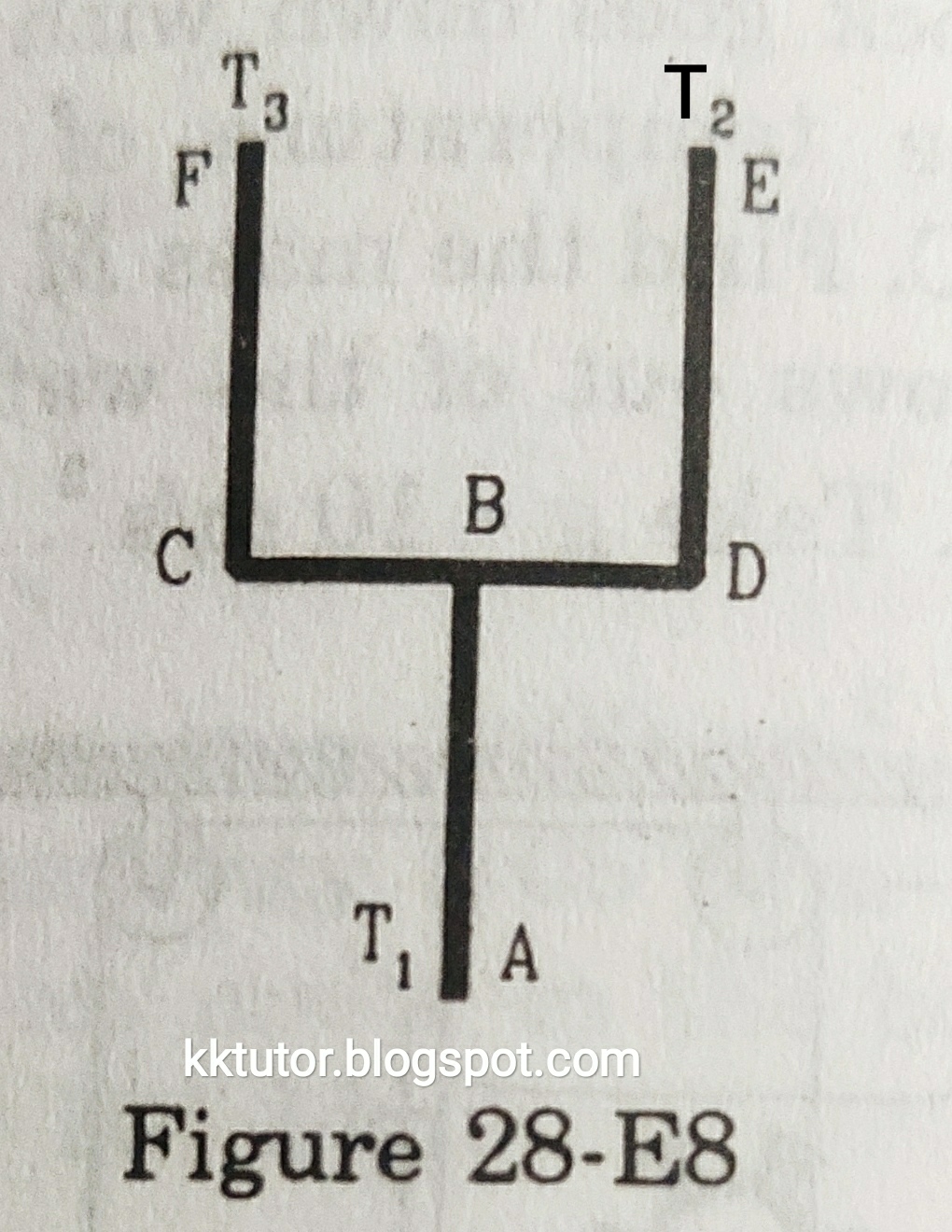
Answer: Let the temperature at B = T. Length of AB = l, length of BDE and BCF = l+l/2 =3l/2.
Assume heat flow rate in AB = Q, in BDE =Q', and in BCF = Q". Then,
Q = Q'+Q"
→KA(T₁-T)/l = KA(T-T₂)/(3l/2) +KA(T-T₃)/(3l/2)
→T₁-T = 2(T-T₂ +T-T₃)/3
→3T₁ -3T = 4T-2T₂-2T₃
→7T = 3T₁+2(T₂+T₃)
→T = {3T₁ +2(T₂+T₃)}/7
32. Seven rods A, B, C, D, E, F and G are joined as shown in figure (28-E9). All the rods have equal cross-sectional area A and length l. The thermal conductivities of the rods are KA = KC = Ko, KB = KD = 2Ko, KE = 3Ko, KF = 4Ko and KG =5Ko. The rod E is kept at a constant temperature T1 and the rod G is kept at a constant temperature T2 (T2>T1).
(a) Show that the rod F has a uniform temperature T =(T₁+2T₂)/3.
(b) Find the rate of heat flow from the source that maintains the temperature T₂. 
Figure for Q-32

Answer: (a) Rods A and C are identical and rods B and D are identical. Hence, the heat flow rate in steady-state in A+B and C+D will also be identical. It means the junction of A and B, as well as the junction of B and C, will have the same temperature. That is, the ends of rod F will have the same temperature, resulting in a uniform temperature in rod F = T (say).
Due to the uniform temperature in F, there will be no heat flow through it. Hence, the heat flow through A = the heat flow through B.
→K₀A(T-T₁)/l = 2K₀A(T₂-T)/l
→T-T₁ =2T₂ -2T
→3T = T₁ +2T₂
→T = (T₁+2T₂)/3.
(b) With the above value of T,
T₂ -T = T₂-(T₁+2T₂)/3
=(T₂-T₁)/3
The rate of heat flow from the source will be the sum of heat flow in rods B and D. The heat flow rate in both of these two rods is the same. Hence, the rate of heat flow from the source
= 2*2KₒA(T₂-T₁)/3l
= 4KₒA(T₂-T₁)/3l.
33. Find the rate of heat flow through a cross-section of the rod shown in Figure (28-E10) (θ₂>θ₁). The thermal conductivity of the material of the rod is K. 
The figure for Q-33

Answer: Consider a section at a distance x from the left end and across a thickness dx; let the temperature difference be = dθ. Radius y here increases by dy across the thickness dx. See the diagram below. 
Diagram for problem-33

From the similar triangles,
dy/dx = (r₂-r₁)/L
→Ldy = (r₂-r₁)dx
Heat flow rate across this section,
Q =K(πy²)dθ/dx
Now y = r₁+x(r₂-r₁)/L
→Q = πK{r₁+x(r₂-r₁)/L}²dθ/dx
→Qdx/{r₁+x(r₂-r₁)/L}² =πKdθ
Integrating, we get,
→-[Q/{r₁+x(r₂-r₁)/L}(r₂-r₁)/L] =πK[θ]
Putting the limits,
{-QL/(r₂-r₁)}*{1/(r₁+r₂-r₁) -1/r₁} =πK(θ₂-θ₁)
→{-QL/(r₂-r₁)}{1/r₂-1/r₁} =πK(θ₂-θ₁)
→{QL/(r₂-r₁)}{(r₂-r₁)/r₁r₂} =πK(θ₂-θ₁)
→ Q = πKr₁r₂(θ₂-θ₁)/L.
34. A rod of negligible heat capacity has length 20 cm, area of cross-section 1.0 cm² and thermal conductivity 200 W/m-°C. The temperature of one end is maintained at 0°C, and that of the other end is slowly and linearly varied from 0°C to 60°C in 10 minutes. Assuming no loss of heat through the sides, find the total heat transmitted through the rod in these 10 minutes.
Answer: Length, L = 20 cm =0.20 m,
Area of cross section, A =1 cm² =0.0001 m².
K =200 W/m-°C.
T =0°C and T' varires from 0°C to 60°C in 10 min i.e. in 600 s,
so T' =(t/600)*60°C =t/10 °C
Suppose dQ heat flows in dt time, then
dQ/dt = KA(T'-T)/L
→dQ = {KA(t/10 -0)/L}*dt
→dQ = (KA/10L)tdt, integrating,
→Q = (KA/10L)[t²/2], putting limit t=0 to 600 s we get
→Q =KA(600)²/20L
=200*0.0001*360000/(20*0.2)
=1800 J.
35. A hollow metallic sphere of radius 20 cm surrounds a concentric metallic sphere of radius 5 cm. The space between the two spheres is filled with nonmetallic material. The inner and outer spheres are maintained at 50°C and 10°C, respectively, and it is found that 100 J of heat passes from the inner sphere to the outer sphere per second. Find the thermal conductivity of the material between the spheres.
Answer: 
Figure for Q-34
Consider a hollow sphere of nonmetallic material between the two spheres of radius r and thickness dr. The temperature difference across the thickness = dθ. If the heat flow rate = H, then

H =K(4πr²)dθ/dr
→Hdr/r² =4πKdθ
Integrating,
-H[1/r] = 4πK[θ]
Putting the value of r from 0.05 m to 0.20 m and θ from 50°C to 10°C.
-H{1/0.20 -1/0.05} = 4πK(50-10)
→-H(5 -20) =4πK*40
→15H =160πK
→K = 15H/160π
→K = 15*100/160π
= 2.98 ≈ 3.0W/m-°C.
36. Figure (28-E11) shows two adiabatic vessels, each containing a mass m of water at different temperatures. The ends of a metal rod of length L, area of cross-section A and thermal conductivity K, are inserted in the water as shown in the figure. Find the time taken for the difference between the temperatures in the vessels to become half of the original value. The specific heat capacity of water is s. Neglect the heat capacity of the rod and the container and any loss of heat to the atmosphere. 
Figure for Q-36

Answer: Let the temperature of the left box =T' and the right box =T''. Difference T =T"-T'.
Initially, the rate of heat flow in a small interval of time dt,
dQ/dt =KA(T"-T')/L
→dQ ={KA(T"-T')/L}dt
If the temperature of the left box in this time dt is H' then,
ms(H'-T') ={KA(T"-T')/L}dt
→H' = T' + {KA(T"-T')/Lms}dt
So the temperature of the left box increases by {KA(T"-T')/Lms}dt and the temperature of the right box decreases by this amount because the mass and specific heat of the water on both sides is the same. Thus the temperature difference will be double this amount.
→dT =-2{KA(T"-T')/Lms}dt
{Negative sign is for, with the increase in time, the temperature difference decreases}
→dT =-{2KAT/Lms)dt
→dt = -(Lms/2KA)(dT/T)
Integrating, we get.
t =-(Lms/2KA)*[lnT]
Since T is the initial temperature difference and T/2 the final difference, the limits of T on the right side will be from T to T/2. Putting the limits,
t = -(Lms/2KA){ln(T/2)-lnT}
=(Lms/2KA){lnT -ln(T/2)}
=(Lms/2KA)*ln2.
37. Two bodies of masses m₁ and m₂ and specific heat capacities s₁ and s₂ are connected by a rod of length l, cross-sectional area A, thermal conductivity K, and negligible heat capacity. The whole system is thermally insulated. At time t = 0, the temperature of the first body is T₁ and the temperature of the second body is T₂(T₂>T₁). Find the temperature difference between the two bodies at time t.
Answer: At time t = 0, the temperature difference T = T₂-T₁. Suppose initially, in a very small time interval dt, the amount of heat transferred is dQ. So,
dQ/dt =KAT/l
→dQ = KATdt/l
If the temperature of the first body after time dt is T', then
m₁s₁(T'-T₁) =KATdt/l
→T' =T₁+(KAT/lm₁s₁)dt
Similarly, the temperature of the second body after time dt will be
T" = T₂-(KAT/lm₂s₂)dt
Now the difference in the temperature =T"-T'.
=(T₂-T₁)+(KAT/l)(-1/m₂s₂ -1/m₁s₁)dt
=(T₂-T₁)-{KA(m₁s₁+m₂s₂)/lm₁s₁m₂s₂}T/dt
=(T₂-T₁)-λT/dt
Where λ ={KA(m₁s₁-m₂s₂)/lm₁s₁m₂s₂}
→(T"-T')-(T₂-T₁)= λT/dt
L.H.S. is the small change in the temperature difference =-dT. The sign of dT is negative because the first term is smaller than the second term on the L.H.S.
→-dT/T =λdt
Integrating,
→ln(T) = -λt
The limit of integration is,
at t = 0, T=T₂-T₁,
and at time t = t, T =T, so
ln{T/(T₂-T₁)} =-λt
By definition of log
→T/(T₂-T₁) = e-λt
→T = (T₂-T₁)e-λt
38. An amount n (in moles) of a monatomic gas at an initial temperature T₀ is enclosed in a cylindrical vessel fitted with a light piston. The surrounding air has a temperature Tₛ (>Tₒ) and the atmospheric pressure is pₐ. Heat may be conducted between the surrounding air and the gas through the bottom of the cylinder. The bottom has a surface area A, thickness x, and thermal conductivity K. Assuming all changes to be slow, find the distance moved by the piston in time t.
Answer: The process is at constant pressure. Suppose dQ heat is transferred in a small time interval dt, then the heat flow rate,
dQ/dt = KA(Tₛ-T)/x
If the temperature of the gas after time dt is T' then,
nCₚ(T'-T) = KA(Tₛ-T)dt/x ---(i)
For a monatomic gas, Cₚ =5R/2, where R is the universal gas constant.
The small change in temperature in time dt, dT =T'-T
Now (i) becomes
5nRdT/2 = KA(Tₛ-T)dt/x
→dT/(Tₛ-T) =(2KA/5Rnx)dt
Integrating, we get,
[-ln(Tₛ-T)] = (2KA/5Rnx)[t]
Now the limits of integration are at t = 0, T = Tₒ, and at t = t, T = T. Putting the limits,
ln(Tₛ-T)/(Tₛ-Tₒ) =-(2KA/5Rnx)t
→Tₛ-T =(Tₛ-Tₒ)e-2KAt/5Rnx
→T =Tₛ-(Tₛ-Tₒ)e-2KAt/5Rnx
Subtracting Tₒ from both sides,
T-Tₒ =(Tₛ-Tₒ)-(Tₛ-Tₒ)e-2KAt/5Rnx→ΔT = (Tₛ-Tₒ)(1-e-2KAt/5Rnx)But pₐV =nRΔT, and V =A*L, where L is the distance moved by the cylinder, sopₐAL/nR =(Tₛ-Tₒ)(1-e-2KAt/5Rnx)→L =(nR/pₐA)(Tₛ-Tₒ)(1-e-2KAt/5Rnx).
39. Assume that the total surface area of a human body is 1.6 m² and that it radiates like an ideal radiator. Calculate the amount of energy radiated per second by the body if the body temperature is 37°C. Stefan constant 𝜎 is 6.0x10⁻⁸܁ W/m²-K⁴.
Answer: Area of the body, A =1.6 m². Body temperature, T = 37°C =273+37 K =310 K. Given, Stefan constant, 𝜎 =6.0x10⁻⁸ W/m²-K⁴.
For an ideal radiator, thermal radiation emitted per unit time is given as,
u = 𝜎AT⁴
=6.0x10⁻⁸*1.6*310⁴ J/s
= 887 J/s
40. Calculate the amount of heat radiated per second by a body of surface area 12 cm² kept in thermal equilibrium in a room at temperature 20°C. The emissivity of the surface =0.80 and 𝜎 = 6.0x10⁻⁸ W/m²-K⁴.
Answer: Surface area of the body, A =12 cm² =0.0012 m². The temperature of the body, T =20+273 K = 293 K. Emissivity of the body, e =0.8 and 𝜎 = 6.0x10⁻⁸ W/m²-K⁴.
The rate of heat radiation is given as,
u =e𝜎AT⁴
=0.8*6.0x10⁻⁸*0.0012*293⁴ J/s
= 0.42 J/s.
41. A solid aluminum sphere and a solid copper sphere of twice the radius are heated to the same temperature and are allowed to cool under identical surrounding temperatures. Assume that the emissivity of both spheres is the same. Find the ratio of (a) the rate of heat loss from the aluminum sphere to the rate of heat loss from the copper sphere and (b) the rate of fall of temperature of the aluminum sphere to the rate of fall of the temperature of the copper sphere. The specific heat capacity of aluminum = 900 J/kg-°C and that of copper = 390 J/kg -°C. The density of copper = 3.4 times the density of aluminum.
Answer: Let the radius of the aluminum sphere = r and that of the copper sphere = 2r.
The surface area of the aluminum sphere, A =4πr².
The surface area of the copper sphere, A' = 4π(2r)² = 16πr².
If the emissivity and the temperature of both the spheres are e and T, then the heat radiation rate from the aluminum sphere,
u = e𝜎AT,
(Where 𝜎 is the Stefen constant)
= e𝜎(4πr²)T
And the heat radiation from the copper sphere,
u' = e𝜎A'T
=e𝜎(16πr²)T
(a) Hence, the ratio of the rate of heat loss from the aluminum sphere to the rate of heat loss from the copper sphere
=u/u'
= e𝜎(4πr²)T/e𝜎(16πr²)T
= 1:4.
(b) Suppose the rate of temperature fall from the aluminum sphere =dT/dt and from the copper sphere =dT'/dt, then the rate of heat radiation from the aluminum sphere,
u = msdT/dt,
and from the copper sphere,
u' = m's'dT'/dt
Where m and m' are masses and s and s' are specific heat capacities of aluminum and copper spheres, respectively. If d is the density of aluminum, then the density of copper =3.4d. Now,
u/u'=
{(4/3)πr³d*900*dT/dt}/{(4/3)π8r³*3.4d*390*dT'/dt}
=(900*dT/dt)/(8*3.4*390*dT'/dt)
=(1/11.79)(dT/dt)/(dT'/dt)
But u/u' = 1/4, so
(dT/dt)/(dT'/dt) =11.79/4
=2.9:1.
42. A 100 W bulb has tungsten filaments of total length 1.0 m and radius 4x10⁻⁵ m. The emissivity of the filament is 0.8 and 𝜎 = 6.0x10⁻⁸ W/m²-K⁴. Calculate the temperature of the filament when the bulb is operating at the correct wattage.
Answer: Heat radiation per unit time,
u = 100 W, e = 0.8,
Area of the wire, A =2π(4x10⁻⁵)*1.0 m². Let the temperature of the wire = T.
Now, u =e𝜎AT⁴
→T⁴ = {100/0.8*6.0x10⁻⁸*2π(4x10⁻⁵)}
→T = (0.83x10¹³)1/4
= 1697.3 K
≈ 1700 K.
43. A spherical ball of surface area 20 cm² absorbs any radiation that falls on it. It is suspended in a closed box maintained at 57°C. (a) Find the amount of radiation falling on the ball per second. (b) Find the net rate of heat flow to or from the ball at an instant when its temperature is 200°C. Stefen constant =6.0x10⁻⁸ W/m²-K⁴.
Answer: (a) Since the ball absorbs any radiation falling on it, its emissivity, e =1. Hence the radiation absorbed per second,
u =𝜎AT⁴.
Here, T =273+57 =330 K,
A = 20 cm² =20x10⁻⁴ m² =2x10⁻³ m²
𝜎 = 6x10⁻⁸ W/m²-K⁴
So, u=6x10⁻⁸*2x10⁻³*330⁴ J/s
=1.42 J/s
(b) The temperature of the ball T'=200°C =273+200 =473 K.
The ball is at a higher temperature; hence the net flow of heat will be from the ball to the surroundings.
The net rate of heat flow from the ball,
=𝜎A(T'⁴-T⁴)
=6x10⁻⁸*2x10⁻³*(473⁴-330⁴)
=4.58 W.
44. A spherical tungsten piece of radius 1.0 cm is suspended in an evacuated chamber maintained at 300 K. The piece is maintained at 1000 k by heating it electrically. Find the rate at which the electrical energy must be supplied. The emissivity of tungsten is 0.30 and the Stefen constant 𝜎 is 6.0x10⁻⁸ W/m²-K⁴.
Answer: The rate of electrical energy to be supplied will be equal to the net loss rate of heat energy, which will be
u =e𝜎A(T'⁴-T⁴)
Here, e =0.3,
A=4π*1² cm² =4π*10⁻⁴ m²
T' =1000 K, T =300 K
Now,
u =0.3*6x10⁻⁸*4π*10⁻⁴(1000⁴-300⁴)
=22.4 W.
45. A cubical block of mass 1.0 kg and edge 5.0 cm is heated to 227°C. It is kept in an evacuated chamber maintained at 27°C. Assuming that the block emits radiation like a blackbody, find the rate at which the temperature of the block will decrease. The specific heat capacity of the material of the block is 400 J/kg-K.
Answer: Mass of the block, m = 1 kg.
The surface area of the block, A = 6*5² cm² =150 cm² =0.015 m².
The temperature of the block,
T' = 227°C = 273+227 =500 K.
The temperature of the chamber,
T =27°C =273+27 =300 K.
Emissivity, e = 1.
Rate of heat radiation,
u =𝜎A(T'⁴-T⁴)
But u =ms(dT/dt)
→dT/dt =𝜎A(T'⁴-T⁴)/ms
=6x10⁻⁸*0.015*(500⁴-300⁴)/(1*400)
=0.12 K/s or 0.12°C/s.
46. A copper sphere is suspended in an elevated chamber maintained at 300 K. The sphere is maintained at a constant temperature of 500 K by heating it electrically. A total of 210 W of electric power is needed to do it. When the surface of the copper sphere is completely blackened, 700 W is needed to maintain the temperature of the sphere. Calculate the emissivity of copper.
Answer: Let the emissivity of copper = e. The power needed to maintain the temperature of the sphere is equal to the net radiation per second by the sphere. So,
u =e𝜎A(T'⁴-T⁴)
When the copper surface is blackened,
e =1, Now the net radiation per second,
u' =𝜎A(T'⁴-T⁴)
The ratio of the two,
u/u' = e,
→e =210/700 = 0.30.
47. A spherical ball A of surface area 20 cm² is kept at the center of a hollow spherical shell B of area 80 cm². The surface of A and the inner surface of B emit as black bodies. Assume that the thermal conductivity of the material of B is very poor and that of A is very high, and that the air between A and B has been pumped out. The heat capacities of A and B are 42 J/°C and 82 J/°C, respectively. Initially, the temperature of A is 100°C, and that of B is 20°C. Find the rate of change of temperature of A and that of B at this instant. Explain the effects of the assumptions listed in the problem.
Answer: Temperature of A, T' =100°C =273+100 =373 K, Area, A' =20 cm² =0.002 m².
Temperature of B, T = 20°C =273+20 =293 K. Area, A =80 cm² =0.008 m².
Emissivity e for both is =1.
Since all the heat radiating out from A falls on the inner surface of B, all of this will be absorbed by B. Heat radiated out by A and received by B = 𝜎A'T'⁴
Heat radiated out by B =𝜎AT⁴. But only a fraction of it (A'/A) will fall on A, and the rest will fall on the inner surface of B itself and be absorbed by it.
Hence net heat radiation received by B,
u =𝜎A'T'⁴ -𝜎AT⁴*(A'/A)
=6x10⁻⁸*0.002(373⁴-293⁴)
=1.44 J/s
But it will be equal to (ms)dT/dt
Hence, (ms)dT/dt =1.44
→dT/dt =1.44/82 = 0.01°C/s
So the rate of change of temperature of B =0.01°C/s.
Now let us consider the surface of A. Since there is no air between the balls, the surrounding temperature can not be taken as T =293 K. It is receiving heat radiation from B at the rate of (A'/A)𝜎AT⁴ =𝜎A'T⁴. From the given assumption, the conductivity of A is very high, which means whatever heat radiation it is receiving, it gets immediately spread evenly to the whole of the sphere A, and a rise in its temperature will be instantaneous. So the rise rate of the temperature due to this received radiation from B,
=𝜎A'T⁴/(m's')
=6x10⁻⁸*0.002*293⁴/(42)
=0.02 °C/s.
This increase in temperature is in a second, which is very small in comparison to the temperature of A =373 K. Hence, the instantaneous rise in temperature of A due to the received radiation from B is negligible, and the heat radiating out from A will be,
u' =𝜎A'T'⁴
=6x10⁻⁸*0.002*373⁴
= 2.32 J/s
Hence the rate of change of temperature of A =u'/(m's')
=2.32/42
=0.05°C/s.
The effects of assumptions in the problem are obvious. If the conductivity of sphere A was not very high, the net radiation received by A would be,
=𝜎A'(T'⁴-T⁴)
=6x10⁻⁸*0.002(373⁴-293⁴)
=1.44 J/s
And the temperature change would have been =1.44/42 =0.03°C/s.
48. A cylindrical rod of length 50 cm and cross-sectional area 1 cm² is fitted between a large ice chamber at 0°C and an evacuated chamber maintained at 27°C as shown in figure (28-E12). Only small portions of the rod are inside the chambers, and the rest is thermally insulated from the surroundings. The cross-section going into the evacuated chamber is blackened so that it completely absorbs any radiation falling on it. The temperature of the blackened end is 17°C when steady-state is reached. Stefen constant 𝜎 = 6x10⁻⁸ W/m²-K⁴. Find the thermal conductivity of the material of the rod.
The figure for Q-48

Answer: Area of the blackened end, A =1 cm² =0.0001 m². The temperature of this end, T =17°C =17+273 =290 K. The temperature of the evacuated chamber, T' = 27°C =27+273 =300 K. Hence, the radiation being received by the black end,
Q/t =𝜎A(T'⁴-T⁴)
=6x10⁻⁸*0.0001(300⁴-290⁴)
=0.0062 J/s
Now, this is the heat current in the steady-state in the rod. Let the conductivity of the rod = K. The temperature difference between the ends, ΔT =17°C =17 K. Length of the rod, L =50 cm =0.50 m. Cross-sectional area, A =0.0001 m².So the heat current in the rod is given as
Q/t =KAΔT/L
→0.0062 =K*0.0001*17/0.50
→K =62*0.50/17
=1.82 W/m-°C
49. One end of a rod of length 20 cm is inserted in a furnace at 800 K. The sides of the rod are covered with an insulating material, and the other end emits radiation like a blackbody. The temperature of this end is 750 K in the steady-state. The temperature of the surrounding air is 300 K. Assuming radiation to be the only important mode of energy transfer between the surrounding and the open end of the rod, find the thermal conductivity of the rod. Stefen constant 𝜎 = 6.0x10⁻⁸ W/m²-K⁴.
Answer: In the steady-state, the heat current in the rod is the same as radiation being lost to the surroundings through the blackbody end. Hence,
KA*ΔT/L =𝜎A(T'⁴-T⁴)
→K =𝜎(T'⁴-T⁴)L/ΔT
=6x10⁻⁸(750⁴-300⁴)*0.20/(800-750)
=74 W/m-K.
50. A calorimeter of negligible heat capacity contains 100 cc of water at 40°C. The water cools to 35°C in 5 minutes. The water is now replaced by K-oil of equal volume at 40°C. Find the time taken for the temperature to become 35°C under similar conditions. Specific heat capacities of water and K-oil are 4200 J/kg-K and 2100 J/kg-K, respectively. Density of K-oil = 800 kg/m³.
Answer: Let the temperature of surrounding = T. Average temperature of water, T' = (40+35)/2 = 37.5 °C.
Average temperature difference from the surrounding =37.5-T
Heat lost by the water,
=0.10*4200(40-35)
=2100 J.
The average rate of heat loss =2100/5 J/min
=420 J/min.
If the conductivity of calorimeter = K, thickness =L and area =A, then
KA(37.5-T)/L =420 ---- (i)
In the case of K-oil,
mass, m =density*volume
= 0.08 kg
Specific heat capacity, s= 2100 J/kg-K.
Heat loss, = 0.08*2100*(40-35)
=168*5 J
=840 J
If the K-oil takes t mins to cool, then heat loss rate =840/t. Now
840/t = KA(37.5-T)/L -------- (ii)
From (i) and (ii)
840/t =420
→t =840/420 =2 min.
51. A body cools down from 50°C to 45°C in 5 minutes and to 40°C in another 8 minutes. Find the temperature of the surroundings.
Answer: Let the temperature of surrounding =T°C.
The average temp in the first case =(50+45)/2 =47.5°C
Temperature difference =47.5-TRate of cooling =(50-45)/5 =1°C/minFrom Newton's law of cooling,dT/dt =-bA(T'-T)→1 =-bA(47.5-T)→bA =1/(T-47.5)
In the second case,Rate of cooling =(45-40)/8 =5/8 °C/min.Average temperature =(45+40)/2 =42.5°C.Temperature difference =42.5-TFrom Newton's law of cooling5/8 =-bA(42.5-T)→5/8 =(T-42.5)/(T-47.5){putting value of bA}→8T-8*42.5 =5T-5*47.5→3T =340-237.5→T =102.5/3 ≈34°C
52. A calorimeter contains 50 g of water at 50°C. The temperature falls to 45°C in 10 minutes. When the calorimeter contains 100 g of water at 50°C, it takes 18 minutes for the temperature to become 45°C. Find the water equivalent of the calorimeter.
Answer: Let the water equivalent of the calorimeter = m grams. Mass of water in calorimeter =50 g.
Heat lost to the surroundings
=(m+50)*10⁻³*s*(50-45) J
=5s(m+50)*10⁻³ J
Rate of heat loss
=5s(m+50)*10⁻³/10 J/min
=5s(m+50)*10⁻⁴ J/min
Where s = specific heat capacity of water.
For the second case, the mass of water =100 g Time of cooling between the same range =18 min.Hence, the rate of heat loss=(m+100)*10⁻³*s*(50-45)/18=5s(m+100)*10⁻³/18 J/minThe rate of heat loss in both cases should be the same. Equating the two, we get,5s(m+100)*10⁻³/18 =5s(m+50)*10⁻⁴→10(m+100)=18(m+50)→8m =1000-900→m =100/8 =12.5 g
53. A metal ball of mass 1 kg is heated by means of a 20 W heater in a room at 20°C. The temperature of the ball becomes steady at 50°C. (a) Find the rate of loss of heat to the surroundings when the ball is at 50°C. (b) Assuming Newton's law of cooling, calculate the rate of loss of heat to the surroundings when the ball is at 30°C. (c) Assume that the temperature of the ball rises uniformly from 20°C to 30°C in 5 minutes. Find the total loss of heat to the surroundings during this period. (d) Calculate the specific heat capacity of the metal.
Answer: (a) Since the ball is at steady-state at 50°C, all the heat given to it is lost to the surroundings at the same rate. Rate of heat given to the ball by the heater =20 W.
Hence the rate of heat loss to the surroundings = 20 W.
(b) At 50°C, rate of cooling dT/dt=20 J/s. From Newton's law of cooling,
dT/dt =-bA(T'-T)
→20=-bA(50-20)
→bA =-2/3
At 30°C, the rate of loss of heat to surrounding,
=-bA(30-20)
=(2/3)*10
=20/3 W.
(c) Average temperature during this period =(20+30)/2 =25°C.
Rate of heat loss during this period
dT/dt=-bA(25-20)
=(2/3)*5 J/s
=10/3 J/s
Time =5 min =300 sTotal loss of heat during this period =(300)*(10/3)=3000/3 J=1000 J.
(d) Heat given to the ball during this time =20*300=6000 JHeat lost during this time =1000 JNet heat given to the ball Q=6000-1000 J=5000 JThe rise in temperature, (T'-T) =30-20 =10°CMass, m = 1 kg,s =specific heat capacity of the metal.Now, Q =ms(T'-T)→5000 =1*s*10→s =500 J/kg-K.
54. A metal block of heat capacity 80 J/°C placed in a room at 20°C is heated electrically. The heater is switched off when the temperature reaches 30°C. The temperature of the block rises at the rate of 2°C/s just after the heater is switched on and falls at the rate of 0.2°C/s just after the heater is switched off. Assume Newton's law of cooling holds. (a) Find the power of the heater. (b) Find the power radiated by the block just after the heater is switched off. (c) Find the power radiated by the block when the temperature of the block is 25°C. (d) Assuming that the power radiated at 25°C represents the average value in the heating process, find the time for which the heater was kept on.
Answer: (a) The rate of increase in temperature =2°C/s.
Power of the heater =Heat given by the heater in one second
=(Heat capacity)*(temperature rise in a second)
=80*2 W
= 160 W.
(b) The rate of temperature fall at 30°C =0.2°C/s.
Hence the power radiated by the block,
=80*0.2 W
=16 W.
(c) At 30°C, rate of cooling =0.2°C. From Newton's Law of cooling,
0.20=-bA(30-20)
→-bA =0.02
At 25°C, rate of cooling,
dT/dt =-bA(25-20)
=0.02*5
=0.10°C/s
Hence the power radiated at 25°C,
=80*0.10 W
=8 W.
(d) Average power radiated =power radiated at 25°C =8 W.
Power of the heater =160 W
Net power received by the block,
=160-8 =152 W.
Net heat received by the block =80*(30-20)
=800 J.
Hence the time for which the heater was kept on,
=Heat received/power received
=800/152 s
= 5.2 s.
55. A hot body placed in a surrounding of temperature θ₀ obeys Newton's law of cooling dθ/dt =-k(θ-θ₀). Its temperature at t=0 is θ₁. The specific heat capacity of the body is s, and its mass is m. Find (a) the maximum heat that the body can lose and (b) the time starting from t = 0 in which it will lose 90% of this maximum heat.
Answer: (a) Since the temperature of the surroundings is θₒ, the maximum fall in temperature will be up to θₒ. Hence, the maximum heat that the body can lose, Q = ms(θ₁-θₒ).
(b) Let the temperature of the body when it loses 90% of the heat =T.
Then, 0.9Q =ms(θ₁-T)
→0.9ms(θ₁-θ₀)=ms(θ₁-T)
→T = θ₁-0.9(θ₁-θ₀)
From Newton's law of cooling,
dθ/dt =-k(θ-θ₀)
→dt =-{1/k(θ-θ₀)}dθ
Integrating both sides within limits {t=0 to t, and temperature from θ₁ to T}
→t =-(1/k)*ln(θ-θ₀)
Put the limits on the right side
t =-(1/k)[ln(T-θ₀) -ln(θ₁-θ₀)]
=(1/k)[ln{(θ₁-θ₀)/(θ₁-0.9(θ₁-θ₀)-θₒ}
=(1/k)[ln(θ₁-θ₀)/(0.1θ₁-0.1θ₀)]
=(ln10)/k.
---------------------------------------------------
Click here for all links → kktutor.blogspot.com
===<<<O>>>===
===<<<O>>>===
My Channel on YouTube → SimplePhysics with KK
Links to the Chapters
Links to the Chapters
CHAPTER-1 - Introduction to Physics
Questions for Short Answers
OBJECTIVE - I
OBJECTIVE - II
EXERCISES (1-10)
EXERCISES (11-19)
CHAPTER-2 - Physics and Mathematics
Questions for Short Answers
Objective - I
Objective - II
Exercises (1 - 19)
Exercises (20 - 35)
CHAPTER-3 - Kinematics - Rest and Motion
Questions for Short Answers
Objective - I
Objective - II
Exercises - Q 1 to Q 10
Exercises - Q 11 to Q 20
Exercises - Q 21 to Q 30
Exercises - Q 31 to Q 40
Exercises - Q 41 to Q 52
CHAPTER-1 - Introduction to Physics
Questions for Short Answers
OBJECTIVE - I
OBJECTIVE - II
EXERCISES (1-10)
EXERCISES (11-19)
CHAPTER-2 - Physics and Mathematics
Questions for Short Answers
Objective - I
Objective - II
Exercises (1 - 19)
Exercises (20 - 35)
CHAPTER-3 - Kinematics - Rest and Motion
Questions for Short Answers
Objective - I
Objective - II
Exercises - Q 1 to Q 10
Exercises - Q 11 to Q 20
Exercises - Q 21 to Q 30
Exercises - Q 31 to Q 40
Exercises - Q 41 to Q 52
Questions for Short Answers
OBJECTIVE - I
OBJECTIVE - II
EXERCISES (1-10)
EXERCISES (11-19)
CHAPTER-2 - Physics and Mathematics
Questions for Short Answers
Objective - I
Objective - II
Exercises (1 - 19)
Exercises (20 - 35)
CHAPTER-3 - Kinematics - Rest and Motion
Questions for Short Answers
Objective - I
Objective - II
Exercises - Q 1 to Q 10
Exercises - Q 11 to Q 20
Exercises - Q 21 to Q 30
Exercises - Q 31 to Q 40
Exercises - Q 41 to Q 52
Apple iPhone 17 Pro Max 256 GB
QARA Wood Laminated Study Table
CHAPTER-4 - The Forces
Questions for Short Answers
Objective - I
Objective - II
Exercises
CHAPTER-5 - Newton's Laws of Motion
Questions for Short Answers
Objective - I
Objective - II
Exercises - Q 1 to Q 12
Exercises - Q 13 to Q 27
Exercises - Q 28 to Q 42
CHAPTER-4 - The Forces
Questions for Short Answers
Objective - I
Objective - II
Exercises
CHAPTER-5 - Newton's Laws of Motion
Questions for Short Answers
Objective - I
Objective - II
Exercises - Q 1 to Q 12
Exercises - Q 13 to Q 27
Exercises - Q 28 to Q 42
Versatile Foldable Plastic Clipboard
with Built-in Storage and Pen Holder
Portronics Beem 440 Smart LED Projector
CHAPTER-6 - Friction
Questions for Short Answers
Objective - I
Objective - II
Exercises - Q 1 to Q 10
Exercises - Q 11 to Q 20
Exercises - Q 21 to Q 31
CHAPTER-7 - Circular Motion
Questions for Short Answers
Objective - I
Objective - II
Exercises - Q 1 to Q 10
Exercises - Q 11 to Q 20
Exercises - Q 21 to Q 30
CHAPTER-8 - Work and Energy
Questions for Short Answers
Objective - I
Objective - II
Exercises - Q 1 to Q 10
Exercises - Q 11 to Q 20
Exercises - Q 21 to Q 30
Exercises - Q 31 to Q 42
Exercises - Q 43 to Q 54
Exercises - Q 55 to Q 64
Questions for Short Answers
Objective - I
Objective - II
Exercises - Q 1 to Q 10
Exercises - Q 11 to Q 20
Exercises - Q 21 to Q 31
CHAPTER-7 - Circular Motion
Questions for Short Answers
Objective - I
Objective - II
Exercises - Q 1 to Q 10
Exercises - Q 11 to Q 20
Exercises - Q 21 to Q 30
CHAPTER-8 - Work and Energy
Questions for Short Answers
Objective - I
Objective - II
Exercises - Q 1 to Q 10
Exercises - Q 11 to Q 20
Exercises - Q 21 to Q 30
Exercises - Q 31 to Q 42
Exercises - Q 43 to Q 54
Exercises - Q 55 to Q 64
HP 15, AMD Ryzen 3 7320U
(8GB LPDDR5, 512GB SSD) FHD
Portronics Portable Laptop
Stand with Adjustable Height, Foldable
ZEBRONICS PRO Rotatable
Laptop Metal Stand,
360° Fidget Rotation, Foldable
CHAPTER- 11 - Gravitation
Questions for Short Answers
OBJECTIVE - I
OBJECTIVE - II
EXERCISES Q-01 TO Q-10
EXERCISES Q-11 TO Q-20
EXERCISES Q-21 TO Q-30
EXERCISES Q-31 TO Q-39 (With Extra 40th problem)
CHAPTER- 11 - Gravitation
Questions for Short Answers
OBJECTIVE - I
OBJECTIVE - II
EXERCISES Q-01 TO Q-10
EXERCISES Q-11 TO Q-20
EXERCISES Q-21 TO Q-30
EXERCISES Q-31 TO Q-39 (With Extra 40th problem)
For Students -Electric Scooty with
Lithium Battery60-80Km Range
40Km/H Speed
Chetak C2501 by Bajaj Auto
High Speed Electric Scooter
with charger
Non RTO-Low Speed Electric Scooter
with Portable Charger
CHAPTER- 14 - Some Mechanical Properties of Matter
Questions for Short Answers
OBJECTIVE-I
OBJECTIVE-II
EXERCISES - Q-1 TO Q-10
EXERCISES - Q -11 TO Q -20
EXERCISES - Q -21 TO Q -32
CHAPTER- 14 - Some Mechanical Properties of Matter
Questions for Short Answers
OBJECTIVE-I
OBJECTIVE-II
EXERCISES - Q-1 TO Q-10
EXERCISES - Q -11 TO Q -20
EXERCISES - Q -21 TO Q -32
Non-RTO-Electric Scooter | 3-Wheeler
Low-Speed for Senior Citizens
& Differently Abled
Manicure Pedicure Nail Tools With Leather Case
Professional 4 Trays Makeup Box
Cosmetics Case Jewelry Organiser
Vanity Make Up Storage Box
Decent => Pro Trolley Bag Set of 3
20, 24, 28 Inch Hard Shell
Polycarbonate with Laptop Compartment
Safari Tazzo 8 Wheels 66cm
Medium Size Trolley Bag, Hard Case
360º Wheeling Small Check in Trolley Bags
CHAPTER- 19 - Optical Instruments
American Tourister Ivy 2.0|Large Size
Check-in Spinner Trolley Bag (79 cm)
360° 8 Wheel Travel Luggage Hard Case
uppercase - Vector (Medium) 65cm
Check-in Sustainable Trolley Bag
Hardsided Anti-Scratch 8 Wheel
Double Spinner Luggage
-----------------------------------------------------------------------------------------
-----------------------------------------------------------------------------------------
Hanke Travel Bag for Man,Trolley Bag Set of 3 in 1 Expandable Foldable Luggage Bag with Wheels
Collapsible Suitcase Large Trolley Bags
--------------------------------------------------------------------------------------------------------------------------
Part-II
Solutions - "Concepts of Physics" Part-II, by H C Verma
CHAPTER- 23 - Heat and Temperature
Questions for Short Answer
OBJECTIVE - I
OBJECTIVE - II
EXERCISES - Q-1 TO Q-10
EXERCISES - Q-11 TO Q-20
EXERCISES - Q-21 TO Q-34
CHAPTER- 24 - Kinetic Theory of Gases
Questions for Short Answer
OBJECTIVE - I
OBJECTIVE - II
EXERCISES - Q1 to Q10
EXERCISES - Q-11 to Q-20
EXERCISES - Q-21 to Q-30
EXERCISES - Q-31 to Q-40
EXERCISES - Q-41 to Q-50
EXERCISES - Q-51 to Q-62
--------------------------------------------------------------------------------------------------------------------------
Solutions - "Concepts of Physics" Part-II, by H C Verma
CHAPTER- 23 - Heat and Temperature
Questions for Short Answer
OBJECTIVE - I
OBJECTIVE - II
EXERCISES - Q-1 TO Q-10
EXERCISES - Q-11 TO Q-20
EXERCISES - Q-21 TO Q-34
CHAPTER- 24 - Kinetic Theory of Gases
Questions for Short Answer
OBJECTIVE - I
OBJECTIVE - II
EXERCISES - Q1 to Q10
EXERCISES - Q-11 to Q-20
EXERCISES - Q-21 to Q-30
EXERCISES - Q-31 to Q-40
EXERCISES - Q-41 to Q-50
EXERCISES - Q-51 to Q-62
Part-II
Solutions - "Concepts of Physics" Part-II, by H C Verma
Questions for Short Answer
OBJECTIVE - I
OBJECTIVE - II
EXERCISES - Q-1 TO Q-10
EXERCISES - Q-11 TO Q-20
EXERCISES - Q-21 TO Q-34
CHAPTER- 24 - Kinetic Theory of Gases
Questions for Short Answer
OBJECTIVE - I
OBJECTIVE - II
EXERCISES - Q1 to Q10
EXERCISES - Q-11 to Q-20
EXERCISES - Q-21 to Q-30
EXERCISES - Q-31 to Q-40
EXERCISES - Q-41 to Q-50
EXERCISES - Q-51 to Q-62
DOCTOR EXTRA SOFT
Men's Sports Shoes
with Memory Foam Cushioned Insole
CHAPTER- 25 - Calorimetry
Questions for Short Answer
OBJECTIVE - I
OBJECTIVE - II
EXERCISES - Q-1 to Q-10
EXERCISES - Q11 to Q-18
CHAPTER- 26 - Laws of Thermodynamics
Questions for Short Answer
OBJECTIVE - I
OBJECTIVE - II
EXERCISES - Q-1 to Q-10
EXERCISES - Q-11 to Q-22
CHAPTER- 25 - Calorimetry
Questions for Short Answer
OBJECTIVE - I
OBJECTIVE - II
EXERCISES - Q-1 to Q-10
EXERCISES - Q11 to Q-18
CHAPTER- 26 - Laws of Thermodynamics
Questions for Short Answer
OBJECTIVE - I
OBJECTIVE - IIQuestions for Short Answer
OBJECTIVE - I
OBJECTIVE - II
EXERCISES - Q-1 to Q-10
EXERCISES - Q11 to Q-18
CHAPTER- 26 - Laws of Thermodynamics
Questions for Short Answer
OBJECTIVE - I
EXERCISES - Q-1 to Q-10
EXERCISES - Q-11 to Q-22
Reebok Men's Running Shoes
EVA Cushioned Breathable Mesh
Sports Shoes for Men | Lightweight
ASIAN Wonder-13 Men's Running Shoe
Lightweight Sports Design, Soft Cushioning
Campus Women Ciara Running Shoes
Cute - SPARX Women Shoes
Puma Unisex-Adult Skyvolt Sneaker
CULT Active Women's Running Shoes
Breathable & Stretchable
RENEE Very Matte
Pack of 4 Matte Lipsticks
Intense Color Pay Off
Reebok Women's Running Shoes
Lightweight Cushioned Sports Shoes
Janasya Women's Turquoise Green
Rayon Foil Print Kurta with Pant
Rajnandini Women Green Cotton
Printed Ready To Wear Patiala Salwar Suit
Soulemo Women Cotton
Floor Length Nighty
3D Wall Panel Wallpaper
Self Adhesive PE Foam Brick Sticker
=====================================
=====================================

No comments:
Post a Comment