Thermal and Chemical Effects of Electric Current
Questions for Short Answer
1. If a constant potential difference is applied across a bulb, the current slightly decreases as time passes and then becomes constant. Explain.
ANSWER: Initially, the bulb filament is at room temperature. As a constant potential difference is applied across the bulb, a part of the electric energy is also converted into heat that raises the temperature of the filament. With the increase in temperature, the resistance of the filament also increases because the resistance is dependent on the temperature. Since the current i = V/R, the current decreases initially.
The heated filament also radiates the heat to the surroundings. After some time, the heat radiated, and the heat produced is balanced, and the resistance of the filament stabilizes, and so does the current.
2. Two unequal resistances R₁ and R₂ are connected across two identical batteries of emf ℇ and internal resistance r (figure 33-Q1). Can the thermal energies developed in R₁ and R₂ be equal in a given time? If yes, what will be the condition?
 |
| The figure for Q-1 |
ANSWER: For the first circuit, the resistance of the circuit =r+R₁,
Current in the circuit, i₁ =Є/(r+R₁)
Similarly, the current in the other circuit, i₂ =Є/(r+R₂)
In a time interval t, the thermal energy developed in the first circuit =i₁²R₁t.
And in the other circuit =i₂²R₂t.
For the two thermal energies to be equal,
i₁²R₁t = i₂²R₂t
→Є²R₁/(r+R₁)² =Є²R₂/(r+R₂)²
→R₁r²+R₁R₂²+2rR₁R₂=r²R₂+R₁²R₂+2rR₁R₂
→r²(R₁ -R₂) -R₁R₂(R₁ -R₂) =0
→(R₁ -R₂)(r² -R₁R₂) =0
Since R₁ ≠R₂,
So, r² = R₁R₂,
→r =√(R₁R₂).
Under these conditions, the thermal energy developed in the two resistors will be equal in a given time interval.
3. When a current passes through a resistor, its temperature increases. Is it an adiabatic process?
ANSWER: In an adiabatic process, there is no exchange of mass and heat between the system and the surroundings. When a current is passed through a resistor, its temperature increases. Due to the temperature difference between the system (resistor) and the surroundings, there is an exchange of heat between them. Thus, it is not an adiabatic process.
4. Apply the first law of thermodynamics to a resistor carrying a current i. Identify which of the quantities ΔQ, ΔU, and ΔW are zero, which are positive, and which are negative.
ANSWER: The first law of thermodynamics states that,
∆U =∆Q -∆W,
where ∆U is the change in the internal energy of the system, ∆Q is the heat added, and ∆W is the work done by the system.
Our given system is only the resistor, and it is not doing work. The potential difference across it does the work on it by pushing the charges (electrons), hence ∆W is negative. ∆U is positive because with the temperature increase, the internal energy of the resistor will increase.
∆Q is the heat added, but no heat is being added here. So ∆Q is zero.
5. Do all the thermocouples have a neutral temperature?
ANSWER: No. There is no neutral temperature above 0°C for the thermocouple the constants a and b have the same sign.
When the cold junction is at 0°C, then the maximum thermo-emf occurs at a temperature θ for the hot junction if θ = -a/b. If the signs of a and b are the same, then θ becomes negative, which will be less than 0°C, and that is not possible because θ is the temperature of the hotter junction.
6. Is inversion temperature always double the neutral temperature? Does the unit of temperature have an effect on deciding this question?
ANSWER: If measured in degree Celcius, the inversion temperature is always double the neutral temperature.
Yes, the above answer is dependent on the unit of temperature. If the unit is other than °C, for eg Kelvin or Fahrenheit, then the statement is not true.
7. Is neutral temperature always the arithmetic mean of the inversion temperature and the temperature of the cold junction? Does the unit of temperature have an effect on deciding the question?
ANSWER: Yes, the neutral temperature is always the arithmetic mean of the inversion temperature and the temperature of the cold junction.
The unit of temperature has no effect on deciding the question. Let us see with an example. Suppose A and C are the temperatures of the cold junction and the inversion temperature of the thermocouple, respectively, in °C. Hence, the neutral temperature, N =(A+C)/2.
In Kelvin, the temperature is 273+A and 273+C. The neutral temperature now is,
={(273+A)+(273+C)}/2
=273+(A+C)/2
=273+N,
What is the neutral temperature in Kelvin?
Similarly, in Fahrenheit, the temperatures are (9A/5+32) and (9C/5+32) respectively. The neutral temperature now,
={(9A/5+32)+(9C/5+32)}/2
={9(A+C)/5 +2*32}/2
=(9/5)(A+C)/2 +32
=9N/5 +32
What is the neutral temperature in Fahrenheit?
So the neutral temperature is always the mean of the cold junction temperature and the inversion temperature.
8. Do the electrodes in an electrolytic cell have fixed polarity like a battery?
ANSWER: No, the electrodes in an electrolytic cell do not have fixed polarity like a battery. Consider an electrolytic cell made of electrolyte AgNO₃ and Ag electrodes. At the electrode connected to the negative terminal of the battery (Cathode), Ag from the electrolyte is deposited, while at the positive connected electrode (Anode), Ag is dissolved in the electrolyte. If we reverse the polarity of the electrodes, the electrolytic cell still works. The only difference is that the deposition and dissolution of Ag are reversed.
9. As temperature increases, the viscosity of liquids decreases considerably. Will this decrease the resistance of an electrolyte as the temperature increases?
ANSWER: The charge in an electrolyte is carried by ions, and due to the viscosity, the ions get resistance in movement. With temperature increase, the viscosity decreases, and ions move more freely, thus the resistance of the electrolyte decreases.
=============
iQOO 15R (Triumph Silver, 8GB RAM, 256GB Storage) | Fastest Snapdragon® 8 Gen 5 in The Segment* |
=============
OBJECTIVE - I
1. Which of the following plots may represent the thermal energy produced in a resistor in a given time as a function of electric current? 
The figure for Q-1

ANSWER: (a)
Explanation: The thermal energy produced in a resistor in a given time t is, U =i²Rt.
Since the R and t are given, i.e., constant, the thermal energy U is proportional to the square of the current. Hence, the curve between U and i is represented as,
U = a.i² {a =Rt}
which is in the form y =ax², that is the equation of a parabola. In the given figure, plot (a) best represents the given condition. Option (a) is correct.
Note: Students should not confuse between the curve (a) and (d) because (d) does not represent y =ax². The reason is, (d) intersects y =x (represented by b) only at origin while the curve y =ax² should intersect y =x at two points, at origin and at (1/a, 1/a). You can find these two points by solving y =x and y =ax².
2. A constant current is passed through a resistor. Taking the temperature coefficient of resistance into account, indicate which of the plots shown in Figure (33-Q3) best represents the rate of production of thermal energy in the resistor. 
The figure for Q-2

ANSWER: (d)
Explanation: Thermal energy dU produced in the resistor in time interval dt,
dU =i²R.dt
Taking the thermal coefficient of resistance into account,
dU =i²R(1 +αT)dt, {T is the temperature differce} .
Here i, R and α are constants.
The rate of production of thermal energy, dU/dt = i²R(1 +αT)
→dU/dt = i²R +i²RαT
→dU/dt =m'T +C
{where m' =i²Rα and C =i²R}
→dU/dt =mt +C ------------ (i)
{Since T is proportional to t, it can be shown as → i²rt =MsT' where r is resistance, M =mass and s =specific heat of the resistor. m is another constant of proportionality.}
(i) is an equation of a straight line which has an intercept on the dU/dt axis =C.
So the plot is a straight line. The slope of the straight line m is positive, hence the plot (d). Option (d) is correct.
3. Consider the following statements regarding a thermocouple.
(A) The neutral temperature does not depend on the temperature of the cold junction.
(B) The inversion temperature does not depend on the temperature of the cold junction.
(a) Both A and B are correct.
(b) A is correct but B is wrong.
(c) B is correct but A is wrong.
(d) Both A and B are wrong.
ANSWER: (b)
Explanation: It has been found that the neutral temperature does not depend on the temperature of the cold junction. But the inversion temperature decreases by x°C where the temperature of the cold junction =0°C +x°C =x°C. So, A is correct and B is wrong. Option (b) is correct.
4. The heat developed in a system is proportional to the current through it.
(a) It cannot be Thomson heat.
(b) It cannot be Peltier heat.
(c) It cannot be Joule heat.
(d) It can be any of the three heats mentioned above.
ANSWER: (c)
Explanation: The Joule heat is always proportional to the square of the current through the system. Hence, it cannot be Joule heat. Option (c) is correct.
5. Consider the following two statements.
(A) Free-electron density is different in different metals.
(B) Free-electron density in a metal depends on temperature.
Seebeck effect is caused,
(a) due to both A and B
(b) due toA but not due to B
(c) due to B but not due to A
(d) neither due to A nor due to B.
ANSWER: (a)
Explanation: Both statements are true to explain the Seebeck effect. Only the fact in A can not cause a current in a thermocouple because the direction of emf at both ends will be equal and opposite. It is also due to the fact in statement B that a net emf is available in the circuit to drive the charges. Option (a) is correct.
6. Consider statements A and B in the previous question. The Peltier effect is caused
(a) due to both A and B
(b) due to A but not due to B
(c) due to B but not due to A
(d) neither due to A nor due to B.
ANSWER: (b)
Explanation: It is due to statement A only. Since the free electron density is different in different materials, a charge has to pass from low density to high density at one and from high to low at the other end when a current is passed through a thermocouple. So, the work done by the electric field on the charge inside the conductors at one end is positive, while on the other end, the work done is negative. Hence, one end is hot and the other is cold. The Peltier effect is not caused by the fact in statement B.
7. Consider statements A and B in question 5. The Thomson effect is caused
(a) due to both A and B
(b) due to A but not due to B
(c) due to B but not due to A
(d) neither due to A nor due to B.
ANSWER: (c)
Explanation: The fact in statement A is for different metals, while the Thomson effect is related to emf produced in a metal wire with the nonuniform temperature at different sections. Hence, option (c) is true.
8. Faraday constant
(a) depends on the amount of the electrolyte.
(b) depends on the current on the electrolyte
(c) is a universal constant
(d) depends on the amount of charge passed through the electrolyte.
ANSWER: (c)
Explanation: The quantity "charge per mole of electrons" is called the Faraday constant. Since the charge on an electron is constant and the number of entities in one mole is constant, it is a universal constant. It neither depends on the amount of electrolyte nor on the amount of charge passed through the electrolyte. It also does not depend on the current in the electrolyte. Option (c) is true. The value of the Faraday constant, F, is equal to 96485 C/mole.
=============
=============
OBJECTIVE - II
1. Two resistors having equal resistances are joined in series and a current is passed through the combination. Neglect any variation in resistance as the temperature changes. In a given time interval,
(a) equal amounts of thermal energy must be produced in the resistors
(b) unequal amounts of thermal energy may be produced
(c) the temperature must rise equally in the resistors
(d) the temperature may rise equally in the resistors.
ANSWER: (a), (d).
Explanation: Since both resistors are connected in series, the same current i passes through them. Suppose the resistance of each of them = R, then in time t, the thermal energy produced in each of them, H = i²Rt. Hence, option (a) is true.
The rise of temperature in resistors
∆T = H/ms, where m =mass of a resistor and s =specific heat of the material.
The product 'ms' may or may not be the same for the resistors. Hence, option (d) is true.
2. A copper strip AB and an iron strip AC are joined at A. Junction A is maintained at 0°C and the free ends B and C are maintained at 100°C. There is a potential difference between
(a) the two ends of the copper strip
(b) the copper end and the iron end at the junction
(c) the two ends of the iron strip
(d) the free ends B and C.
ANSWER: All.
Explanation: The two ends of the copper strip are at different temperatures, hence there will be emf between the two ends (Thomson effect). So there is a potential difference between the two ends of the copper strip. Option (a) is true.
Though the temperature of the ends of copper and iron strips at the junction is the same, there will be a potential difference between these two ends of the metals due to the Peltier emf developed on account of the different natures of the metals. Option (b) is true.
Option (c) is correct exactly due to the reason mentioned in explanation (a).
The nature of the materials of strips AB and AC are different. Also, the lengths may be different. Hence, the potential difference between A and B (say α) and the potential difference between A and C (say ß) will be different. So there will be a potential difference between free ends B and C equal to α-ß. Option (d) is also correct.
So, all options are correct.
3. The constants a and b for the pair silver-lead are 2.50 µV/°C and 0.012 µV/(°C)², respectively. For a silver-lead thermocouple with a colder junction at 0°C,
(a) there will be no neutral temperature
(b) there will be no inversion temperature
(c) there will not be any thermo-emf even if the junctions are kept at different temperatures
(d) there will be no current in the thermocouple even if the junctions are kept at different temperatures.
ANSWER: (a), (b).
Explanation: Since the signs of the constants a and b are the same, there will be no neutral temperature or inversion temperature above 0°C for the silver-lead thermocouple. Options (a) and (b) are correct.
The two junctions, if kept at different temperatures, will have different Peltier EMFs. Thus, there will be a net thermo-emf and hence a current between the two junctions. So, options (c) and (d) are not correct.
4. An electrolysis experiment is stopped and the battery terminals are reversed.
(a) The electrolysis will stop
(b) The rate of liberation of material at the electrodes will increase
(c) The rate of liberation of material will remain the same.
(d) Heat will be produced at a greater rate.
ANSWER: (c)
Explanation: With the reversal of the terminal, only the polarity of the terminals will change. The potential difference across the electrodes and the resistance of the electrolyte will remain the same. Since the current in the electrolyte is due to the movement of ions in the electrolyte, the movement of the ions will now be reversed. The rate of liberation of material will remain the same. Option (c) is correct.
5. The electrochemical equivalent of a material depends on
(a) the nature of the material
(b) the current through the electrolyte containing the material
(c) the amount of charge passed through the electrolyte
(d) the amount of material present in the electrolyte.
ANSWER: (a)
Explanation: The electrochemical equivalent of a material is the ratio of the relative atomic mass of the substance to its valency. Since the atomic mass and the valency of a substance are the nature of the substance, option (a) is correct.
==============
==============
Exercises
1. An electric current 2.0 A passes through a wire of resistance 25 Ω. How much heat will be developed in 1 minute?
ANSWER: Given, i = 2.0 A, R =25 Ω,
t =1 minute =60 s.
The heat produced in this duration,
H = i²Rt
=2²*25*60 J
=6000 J
=6.0x10³ J.
2. A coil of resistance 100 Ω is connected across a battery of emf 6·0 V. Assume that the heat developed in the coil is used to raise its temperature. If the heat capacity of the coil is 4·0 J/K, how long will it take to raise the temperature of the coil by 15°C?
ANSWER: Heat capacity of the coil =4·0 J/K, which means that to raise the temperature of the coil by 1°C, it requires 4·0 J. Hence, to raise the temperature by 15°C, the heat required =4·0*15 =60 J.
Now, given that R =100 Ω, V =6·0 volts. So the heat produced per second
=V²/R
=6²/100 J
=0·36 J.
Time required to produce 6 J heat at this rate =60/0·36 s
=6000/36 s
=1000/(6*60) minutes
=2·8 minutes.
3. The specification on a heater coil is 250 V, 500 W. Calculate the resistance of the coil. What will be the resistance of a coil of 1000 W to operate at the same voltage?
ANSWER: Let the resistance of the coil =R. Given that at the potential difference of V =250 volts, the power of the coil, P =500 W.
Since the power, P =V²/R,
→R =V²/P
=250²/500 Ω
=125 Ω.
If we need to produce a power of 1000 W at the same voltage, the required resistance of the coil is
R =250²/1000 Ω
=62·5 Ω.
4. A heater coil is to be constructed with a nichrome wire (⍴ =1·0x10⁻⁶ Ω-m) which can operate at 500 W when connected to a 250 V supply. (a) What would be the resistance of the coil? (b) If the cross-sectional area of the wire is 0·5 mm², what length of the wire will be needed? (c) If the radius of each turn is 4·0 mm, how many turns will be there in the coil?
ANSWER: (a) Power, P =500 W, the potential difference across the heater coil, V =250 volts,
then P =V²/R, where R = resistance of the coil.
→R =V²/P
=250²/500 Ω
=125 Ω.
(b) Since, ⍴ =RA/l, where A is the area of cross-section and l is the length of the wire. Given A =0·5 mm² =5·0x10⁻⁷ m². Hence, the needed length of the wire,
l =RA/⍴
=125*5·0x10⁻⁷/(1·0x10⁻⁶) m
=625/10 m
=62·5 m
(c) Radius of each turn of the coil =4·0 mm (given). Length of the wire in one turn =2πr =2π*4 mm =8π mm,
Since the length of the wire is 62·5 m, the number of turns in the coil,
=62·5*1000/(8π)
=2488·10 turns
≈2500 turns.
5. A bulb with a rating of 250 V, 100 W is connected to a power supply of 220 V situated 10 m away using a copper wire of an area of cross-section 5 mm². How much power will be consumed by the connecting wires? The resistivity of copper = 1.7x10⁻⁸ Ω-m.
ANSWER: The rating is 250 V, 100 W. Hence, the resistance of the bulb,
R =V²/P
=250²/100 Ω
=625 Ω
The bulb is 10 m away from the source, so the total length of the copper connecting wire =2*10 =20 m. The resistance of this wire, r = ⍴l/A.
Given ⍴ =1·7x10⁻⁸, A =5 mm² =5x10⁻⁶ m
So, r =1·7x10⁻⁸*20/(5x10⁻⁶) Ω
=6·8x10⁻² Ω
Now the source =220 V, total resistance of the bulb and the copper wire,
R' =R +r =625 +6·8x10⁻² Ω
=625·068 Ω
Current in the circuit, i =V/R'
→i =220/625·068 =0·352 A
(Note: even neglecting the copper wire resistance for calculating the current, we get the same current)
Thus, the power consumed in the connecting wire =i²R'
=(0·352)²*6·8x10⁻² W
=0·0084 W
=8·4 mW.
6. An electric bulb, when connected across a power supply of 220 V, consumes a power of 60 W. If the supply drops to 180 V, what will be the power consumed? If the supply is suddenly increased to 240 V, what will be the power consumed?
ANSWER: V =220 volts, P =60 W, so the resistance of the bulb's coil,
R =V²/P
=220²/60 Ω
=806.70 Ω
When V =180 volts, the power consumed by the bulb =V²/R
=180²/806·70
≈40 W.
For V =240 volts, the power consumed by the bulb
=V²/R
=240²/806·70 W
=71·40 W.
7. A servo voltage stabilizer restricts the voltage output to 220 V 士1%. If an electric bulb rated at 220 V, 100 W is connected to it, what will be the minimum and maximum power consumed by it?
ANSWER: The resistance of the bulb,
R =V²/P
=220²/100 Ω
=484 Ω.
The voltage range is from 220-2·2 =217·8 volts to 220+2·2=222·2 volts. Hence, the minimum power consumed,
=V²/R
=(217·8)²/484 Ω
=98 W
and the maximum power consumed,
=(222·2)²/484 Ω
=102 W.
8. An electric bulb marked 220 V, 100 W will get fused if it is made to consume 150 W or more. What voltage fluctuation will the bulb withstand?
ANSWER: The resistance of the bulb,
=V²/P
=220²/100 Ω
=484 Ω
The bulb gets fused at 150 W or more. Hence, the voltage at this power
V²/R =P
→V² =PR
=150*484 =72600
→V =270 volts.
Hence, the bulb will withstand a voltage up to 270 V.
9. An immersion heater rated 1000 W, 220 V is used to heat 0.01 m³ of water. Assuming that the power is supplied at 220 V and 60% of the power supplied is used to heat the water, how long will it take to increase the temperature of the water from 15°C to 40°C?
ANSWER: The temperature difference of the water ΔT =40°C -15°C =25°C.
Mass of water, m = 0.01*1000 kg
=10 kg
Specific heat of water, s =4200 J/kg-K
Hence, the heat required by the given quantity of water to raise the temperature from 15°C to 40°C,
=ms.ΔT
=10*4200*25 J
=1·05x10⁶ J
Given that 60% of the power supplied by the heater is used to heat the water, hence for 1·05x10⁶ J used for heating, the energy supplied by the heater
=1·05x10⁶/0·60 J
=1·75x10⁶ J
Suppose the time taken by the 1000 W heater to produce this amount of energy = t.
Then, 1000*t =1·75x10⁶
→t =1·75x10³ s
≈29 minutes.
10. An electric kettle used to prepare tea, takes 2 minutes to boil 4 cups of water (1 cup contains 200 cc of water) if the room temperature is 25°C. (a) If the cost of power consumption is Rs. 1.00 per unit (1 unit = 1000 Watt-hour), calculate the cost of boiling 4 cups of water. (b) What will be the corresponding cost if the room temperature drops to 5°C?
ANSWER: (a) Amount of water =4*200 cc
=800 cc
Thus, the mass of water m =0.80 kg
Temperature difference,
ΔT =100°C -25°C =75°C.
Heat supplied by the kettle =ms.ΔT
=0.80*4200*75 J
=2.52x10⁵ J
1 unit =1000 W-hour
=1000*3600 J
=36x10⁵ J
Cost of 1 unit of energy = Rs 1.00
Hence cost of boiling 4 cups of water,
=(2.52x10⁵)/(36x10⁵) rupees
=0.07 rupees
=7 paise.
(b) If the room temperature is 5°C, the temperature difference ΔT =100°C-5°C
=95°C
The heat needed to boil =msΔT
=0.80*4200*95 J
=3.192x10⁵ J
Now the cost of boiling,
=(3.192x10⁵)/(36x10⁵) rupees
=0.09 rupees
=9 paise.
11. The coil of an electric bulb takes 40 watts to start glowing. If more than 40 W is supplied, 60% of the extra power is converted into light and the remaining into heat. The bulb consumes 100 Watt at 220 V. Find the percentage drop in the light intensity at a point if the supply voltage changes from 220 V to 200 V.
ANSWER: Rating of the bulb -100 W at 220 V. Hence, the resistance of the bulb coil R =V²/P
=220²/100 Ω
=484 Ω.
When the voltage drops to 200 V, the power consumed by the bulb,
=V²/R
=200²/484 W
=82.65 W
Above 40 W, 60% of power is converted to light. Initially, the power converted to light =0.60(100 W -40 W)
=36 W
When the voltage drops to 200 V, the power converted to light,
=0.60(82.65 W -40 W)
=25.59 W
The drop in power for light =36 -25.59 W
=10.41 W
Since the intensity of light is proportional to the power, the percentage drop in light intensity,
=10.41*100/36
=29%
12. The 2.0 Ω resistor shown in Figure (33-E1) is dipped into a calorimeter containing water. The heat capacity of the calorimeter together with water is 2000 J/K. (a) If the circuit is active for 15 minutes, what would be the rise in the temperature of the water? (b) Suppose the 6.0 Ω resistor gets burnt. What would be the rise in the temperature of the water in the next 15 minutes? 
The figure for Q-12
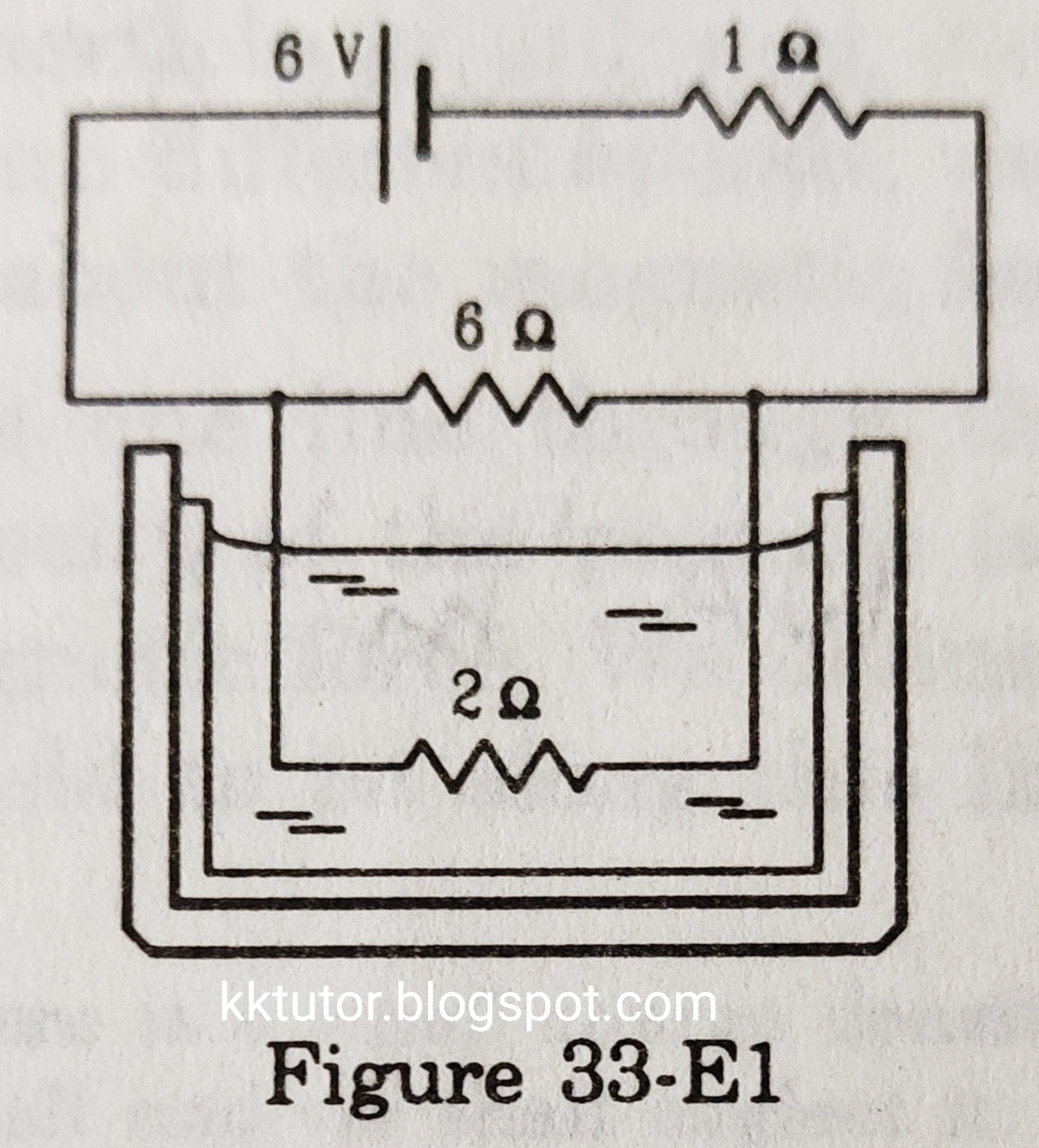
ANSWER: (a) Heat capacity of calorimeter with water C =2000 J/K.
6 Ω and 2 Ω resistors are in parallel, its equivalent resistance,
R' =6*2/(6+2) Ω
=1·5 Ω
Other resistance in the circuit R" =1 Ω
The total resistance of the circuit,
R =R' +R"
=1·5 +1 =2·5 Ω
Current in the circuit, i =6/2·5 =2·4 A
Let the current in the 2 Ω resistor =i', then the current in the 6 Ω resistor will be =i -i'.
The voltage difference across both parallel resistors will be the same. Hence,
i'*2 =(i -i')*6
→2i' +6i' =6i
→8i' =6i
→i' =3i/4 =3*2·4/4 A
→i' =1·8 A.
If the circuit is active for 15 minutes, the heat transferred to the calorimeter,
H =i'²*2*(15*60) J
=(1·8)²*1800 J
=5832 J
The rise in the temperature of the water,
=H/C
=5832/2000 °C
=2·9°C.
(b) When the 6 Ω resistor gets burnt, the total resistance in the circuit,
R =2 Ω +1 Ω =3 Ω
Current in the circuit, i =6/3 =2 A.
Now the heat transferred to the calorimeter by the 2 Ω resistor in the next 15 minutes,
H =i²Rt
=2²*2*(15*60) J
=8*900 J =7200 J
Rise in the temperature of the water due to this amount of heat,
=7200/2000 =3·6°C.
==============
iPhone 17 Pro 512 GB: 15.93 cm (6.3″) Display with Promotion up to 120Hz, A19 Pro Chip, Breakthrough Battery Life, Pro Fusion Camera System with Center Stage Front Camera; Cosmic Orange
==============
13. The temperatures of the junctions of a bismuth silver thermocouple are maintained at 0°C and 0.001°C. Find the thermo-emf (Seebeck emf) developed. For bismuth-silver, a =-46x10⁻⁶ V/deg and b =-0.48x10⁻⁶ V/deg².
ANSWER: The thermo-emf of a thermocouple having one end at 0°C and the other at θ is given as
Ɛ =aθ +½bθ²
=(-46x10⁻⁶)*0·001 +½(-0·48x10⁻⁶)*(0·001)²
=-4·6x10⁻⁸ -2·4x10⁻¹³ V
=-4·6x10⁻⁸ V.
{Since the 2nd term is negligible in comparison with the first term}.
14. Find the thermo-emf developed in a copper-silver thermocouple when the junctions are kept at 0°C and 40°C. Use the data in the table (33.1).
ANSWER: Here θ =40°C. From table (33.1),
acs =(2·76-2·50) µV/°C
=0·26 µV/°C
bcs =(0·012 -0·012) µV/(°C)² =0
Hence, the thermo-emf of the given Copper-Silver thermocouple is
Ɛcs =acsθ +½bcsθ²
=0·26*40 µV
=10·4 µV
=1·04x10⁻⁵ V.
15. Find the neutral temperature and inversion temperature of a copper-iron thermocouple if the reference junction is kept at 0°C. Use the data in the table (33.1).
ANSWER: When one end of a thermocouple is kept at 0°C and the temperature of the other end θ is varied then the neutral temperature is the value of θ for which the maximum thermo-emf is developed in the thermocouple. The neutral temperature is at
θ = -a/b
From table (33.1),
a =2·76 -16·6 = -13·84 µV/°C
and b =0·012 -(-0·030) µV/(°C)²
=0·042 µV/(°C)²
Hence, the neutral temperature of the given thermocouple
= -(-13·84)/0·042 °C
=329·5°C
≈330°C.
Given the temperature of the cold junction
θ' =0°C
Neutral temperature, θ =329·5°C
Inversion temperature, θ" =?
We know the relation among these three temperatures is
θ -θ' = θ" -θ
→θ" =2θ -θ'
=2*329·5 -0 =659°C.
16. Find the charge required to flow through an electrolyte to liberate one atom of (a) a monovalent material and (b) a divalent material.
ANSWER: (a) One atom of a monovalent material will require the charge of one electron to flow through the electrolyte to liberate, which is equal to
q =1·602x10⁻¹⁹ C
(b) Similarly, one atom of a divalent material will require the charge of two electrons to flow through the electrolyte to liberate, which is equal to 2q.
2q =2*1·602x10⁻¹⁹ C
=3·204x10⁻¹⁹ C.
17. Find the amount of silver liberated at the cathode if 0.500 A of current is passed through the AgNO₃ electrolyte for 1 hour. The atomic weight of silver is 107·9 g/mole.
ANSWER: Since silver is monovalent, one mole of silver ion will require one mole of electrons to be liberated at the cathode. The charge of one mole of electrons is 1 faraday =96485 C. So 96485 C will liberate 107·9 g of silver, which is the gram-equivalent of silver.
The amount of charge flown through the electrolyte, q =Current*time
→q =(0·500 A)*(1x3600 s)
=1800 C
Hence the amount of silver liberated at cathode =(107·9)*1800/96485 g
=2·01 g.
You may also put values directly into the formula, m =(1/K)EQ.
18. An electroplating unit plates 3·0 g of silver on a brass plate in 3·0 minutes. Find the current used by the unit. The electrochemical equivalent of silver is 1.12x10⁻⁶ kg/C.
ANSWER: Given, Z=1.12x10⁻⁶ kg/C,
m = 3·0 g =0.003 kg,
time t =3·0 minute =180 s.
If i is the current used, then
m =Zit
→0·003 =1·12x10⁻⁶*i*180
→i =0·003/(1·12x10⁻⁶*180) A
→i = 14·90 A ≈15 A
19. Find the time required to liberate 1·0 liter of hydrogen at STP in an electrolytic cell by a current of 5·0 A.
ANSWER: Given, i =5·0 A. One gram mole of an ideal gas occupies 22·4 liters of volume at STP. Hence 1·0 liter of hydrogen has 1/22·4 =0·0446 moles at STP. Mass of one mole of hydrogen =2 g because one molecule of hydrogen contains 2 atoms. The mass of 0·0446 moles of hydrogen, m =0·0446*2 g =8·892x10⁻⁵ kg.
E = chemical equivalent of hydrogen
=(relative atomic mass)/valency
=1/1 =1·0
Mass of the substance liberated,
m =EQ/K
→m =Eit/K
→t =mK/Ei
=(8·892x10⁻⁵)*9.6485x10⁷/(1·0*5·0) s
=1716 s
=1716/60 minutes
≈29 minutes.
20. Two voltameters, one having a solution of silver salt and the other of a trivalent-metal salt, are connected in series and a current of 2 A is maintained for 1·50 hours. It is found that 1·00 g of the trivalent metal is deposited. (a) What is the atomic weight of the trivalent metal? (b) How much silver is deposited during this period? The atomic weight of silver is 107·9 g/mole.
ANSWER: The amount of charge passing through each voltameter is,
Q =it =2*1.5*3600 C
=10800 C.
(a) Let the atomic weight of the trivalent-metal =M.
Its Chemical equivalent, E =M/3,
Liberated mass, m =1 g =0·001 kg
m =EQ/K
→0·001 =(M/3)*10800/9.6485x10⁷
→M =3*96485/10800
= 26·8 g/mole.
(b) Valency of silver = 1, hence
E =107·9/1 =107·9 g
Silver deposited in this period,
=EQ/K
=107·9*10800/9·6485x10⁷ kg
=0·0121 kg
=12·1 g.
21. A brass plate having a surface area of 200 cm² on one side is electroplated with 0·10 mm thick silver layers on both sides using a 15 A current. Find the time taken to do the job. The specific gravity of silver is 10·5 and its atomic weight is 107·9 g/mol.
ANSWER: Volume of the electroplated silver,
=(2*200)*(0·10/10) cm³
=4 cm³.
Given that, the specific gravity of silver
=10·5
Hence its density =10·5 g/cm³
Thus, the electroplated mass of silver,
m =4*10·5 g =42 g =0.042 kg
Valency of silver is 1, hence its chemical equivalent, E = 107·9/1 =107·9 g.
Let the time taken in this job = t seconds. Since the current i = 15 A,
Charge passed through the electrolyte,
Q =it =15t,
Now, m =EQ/K
→0·042 =107·9*15t/(9.6485x10⁷)
→t =0·042*9.6485x10⁷/(107·9*15)
=2504 s
=42 minutes.
22. Figure (33-E2) shows an electrolyte of AgCl through which a current is passed. It is observed that 2·68 g of silver is deposited in 10 minutes on the cathode. Find the heat developed in the 20 Ω resistor during this period. The atomic weight of silver is 107·9 g/mole. 
The figure for Q-22

ANSWER: We know, m =EQ/K,
→m =Eit/K,
→i =mK/Et.
We have, m =2.68 g =2.68x10⁻³ kg
K =9·6485x10⁷ C/kg,
For silver E =107·9/1 =107·9 g
t =10 minutes =600 s.
Hence current in the circuit,
i =(2.68x10⁻³*9.6485x10⁷)/(107·9*600) A
=4·0 A
So the heat developed in the 20 Ω resistor during this period,
= i²Rt
=(4·0)²*20*600 J
=192000 J
=192 kJ.
23. The potential difference across the terminals of a battery of emf 12 V and internal resistance 2 Ω drops to 10 V when it is connected to a silver voltameter. Find the silver deposited at the cathode in half an hour. The atomic weight of silver is 107·9 g/mole.
ANSWER: Let the current in the circuit = i.
Since the internal resistance of the battery =2 Ω, and due to this, the potential difference across the terminals drops by 2 V, hence,
i*(2 Ω) =2 V,
→i =1 A.
Hence, the silver deposited at the cathode in half an hour,
m =EQ/K
=107·9*(1 A*30*60 s)/(9·6485x10⁷) kg
=0·00201 kg
=2·01 g.
24. A plate of area 10 cm² is to be electroplated with copper (density 9000 kg/m³) to a thickness of 10 micrometers on both sides, using a cell of 12 V. Calculate the energy spent by the cell in the process of deposition. If this energy is used to heat 100 g of water, calculate the rise in the temperature of the water. ECE of copper =3x10⁻⁷ kg/C and specific heat capacity of water =4200 J/kg-K.
ANSWER: Volume of the copper deposited,
=(2*10/10000)*10x10⁻⁶ m³
=2x10⁻⁸ m³
Mass of the copper deposited,
m =2x10⁻⁸*9000 kg
=1·8x10⁻⁴ kg
Let the current supplied by the 12 V cell =i, then
m =Zit
→it =m/Z
=1·8x10⁻⁴/(3x10⁻⁷) C
=600 C
Hence, the energy spent by the cell,
=V*it
=12*600 J
=7200 J
=7·2 kJ.
If this energy is spent to heat 100 g (=0.10 kg) of water, the rise in temperature of the water,
=H/(ms)
=7200/(0·10*4200) K
≈17 K
==============
Click here for all links → kktutor.blogspot.com
===<<<O>>>===
===<<<O>>>===
My Channel on YouTube → SimplePhysics with KK
Links to the Chapters
Links to the Chapters
CHAPTER-1 - Introduction to Physics
Questions for Short Answers
OBJECTIVE - I
OBJECTIVE - II
EXERCISES (1-10)
EXERCISES (11-19)
CHAPTER-2 - Physics and Mathematics
Questions for Short Answers
Objective - I
Objective - II
Exercises (1 - 19)
Exercises (20 - 35)
CHAPTER-3 - Kinematics - Rest and Motion
Questions for Short Answers
Objective - I
Objective - II
Exercises - Q 1 to Q 10
Exercises - Q 11 to Q 20
Exercises - Q 21 to Q 30
Exercises - Q 31 to Q 40
Exercises - Q 41 to Q 52
CHAPTER-1 - Introduction to Physics
Questions for Short Answers
OBJECTIVE - I
OBJECTIVE - II
EXERCISES (1-10)
EXERCISES (11-19)
CHAPTER-2 - Physics and Mathematics
Questions for Short Answers
Objective - I
Objective - II
Exercises (1 - 19)
Exercises (20 - 35)
CHAPTER-3 - Kinematics - Rest and Motion
Questions for Short Answers
Objective - I
Objective - II
Exercises - Q 1 to Q 10
Exercises - Q 11 to Q 20
Exercises - Q 21 to Q 30
Exercises - Q 31 to Q 40
Exercises - Q 41 to Q 52
Questions for Short Answers
OBJECTIVE - I
OBJECTIVE - II
EXERCISES (1-10)
EXERCISES (11-19)
CHAPTER-2 - Physics and Mathematics
Questions for Short Answers
Objective - I
Objective - II
Exercises (1 - 19)
Exercises (20 - 35)
CHAPTER-3 - Kinematics - Rest and Motion
Questions for Short Answers
Objective - I
Objective - II
Exercises - Q 1 to Q 10
Exercises - Q 11 to Q 20
Exercises - Q 21 to Q 30
Exercises - Q 31 to Q 40
Exercises - Q 41 to Q 52
Apple iPhone 17 Pro Max 256 GB
QARA Wood Laminated Study Table
CHAPTER-4 - The Forces
Questions for Short Answers
Objective - I
Objective - II
Exercises
CHAPTER-5 - Newton's Laws of Motion
Questions for Short Answers
Objective - I
Objective - II
Exercises - Q 1 to Q 12
Exercises - Q 13 to Q 27
Exercises - Q 28 to Q 42
CHAPTER-4 - The Forces
Questions for Short Answers
Objective - I
Objective - II
Exercises
CHAPTER-5 - Newton's Laws of Motion
Questions for Short Answers
Objective - I
Objective - II
Exercises - Q 1 to Q 12
Exercises - Q 13 to Q 27
Exercises - Q 28 to Q 42
Versatile Foldable Plastic Clipboard
with Built-in Storage and Pen Holder
Portronics Beem 440 Smart LED Projector
CHAPTER-6 - Friction
Questions for Short Answers
Objective - I
Objective - II
Exercises - Q 1 to Q 10
Exercises - Q 11 to Q 20
Exercises - Q 21 to Q 31
CHAPTER-7 - Circular Motion
Questions for Short Answers
Objective - I
Objective - II
Exercises - Q 1 to Q 10
Exercises - Q 11 to Q 20
Exercises - Q 21 to Q 30
CHAPTER-8 - Work and Energy
Questions for Short Answers
Objective - I
Objective - II
Exercises - Q 1 to Q 10
Exercises - Q 11 to Q 20
Exercises - Q 21 to Q 30
Exercises - Q 31 to Q 42
Exercises - Q 43 to Q 54
Exercises - Q 55 to Q 64
Questions for Short Answers
Objective - I
Objective - II
Exercises - Q 1 to Q 10
Exercises - Q 11 to Q 20
Exercises - Q 21 to Q 31
CHAPTER-7 - Circular Motion
Questions for Short Answers
Objective - I
Objective - II
Exercises - Q 1 to Q 10
Exercises - Q 11 to Q 20
Exercises - Q 21 to Q 30
CHAPTER-8 - Work and Energy
Questions for Short Answers
Objective - I
Objective - II
Exercises - Q 1 to Q 10
Exercises - Q 11 to Q 20
Exercises - Q 21 to Q 30
Exercises - Q 31 to Q 42
Exercises - Q 43 to Q 54
Exercises - Q 55 to Q 64
HP 15, AMD Ryzen 3 7320U
(8GB LPDDR5, 512GB SSD) FHD
Portronics Portable Laptop
Stand with Adjustable Height, Foldable
ZEBRONICS PRO Rotatable
Laptop Metal Stand,
360° Fidget Rotation, Foldable
CHAPTER- 11 - Gravitation
Questions for Short Answers
OBJECTIVE - I
OBJECTIVE - II
EXERCISES Q-01 TO Q-10
EXERCISES Q-11 TO Q-20
EXERCISES Q-21 TO Q-30
EXERCISES Q-31 TO Q-39 (With Extra 40th problem)
CHAPTER- 11 - Gravitation
Questions for Short Answers
OBJECTIVE - I
OBJECTIVE - II
EXERCISES Q-01 TO Q-10
EXERCISES Q-11 TO Q-20
EXERCISES Q-21 TO Q-30
EXERCISES Q-31 TO Q-39 (With Extra 40th problem)
For Students -Electric Scooty with
Lithium Battery60-80Km Range
40Km/H Speed
Chetak C2501 by Bajaj Auto
High Speed Electric Scooter
with charger
Non RTO-Low Speed Electric Scooter
with Portable Charger
CHAPTER- 14 - Some Mechanical Properties of Matter
Questions for Short Answers
OBJECTIVE-I
OBJECTIVE-II
EXERCISES - Q-1 TO Q-10
EXERCISES - Q -11 TO Q -20
EXERCISES - Q -21 TO Q -32
CHAPTER- 14 - Some Mechanical Properties of Matter
Questions for Short Answers
OBJECTIVE-I
OBJECTIVE-II
EXERCISES - Q-1 TO Q-10
EXERCISES - Q -11 TO Q -20
EXERCISES - Q -21 TO Q -32
Non-RTO-Electric Scooter | 3-Wheeler
Low-Speed for Senior Citizens
& Differently Abled
Manicure Pedicure Nail Tools With Leather Case
Professional 4 Trays Makeup Box
Cosmetics Case Jewelry Organiser
Vanity Make Up Storage Box
Decent => Pro Trolley Bag Set of 3
20, 24, 28 Inch Hard Shell
Polycarbonate with Laptop Compartment
Safari Tazzo 8 Wheels 66cm
Medium Size Trolley Bag, Hard Case
360º Wheeling Small Check in Trolley Bags
CHAPTER- 19 - Optical Instruments
American Tourister Ivy 2.0|Large Size
Check-in Spinner Trolley Bag (79 cm)
360° 8 Wheel Travel Luggage Hard Case
uppercase - Vector (Medium) 65cm
Check-in Sustainable Trolley Bag
Hardsided Anti-Scratch 8 Wheel
Double Spinner Luggage
-----------------------------------------------------------------------------------------
-----------------------------------------------------------------------------------------
Hanke Travel Bag for Man,Trolley Bag Set of 3 in 1 Expandable Foldable Luggage Bag with Wheels
Collapsible Suitcase Large Trolley Bags
--------------------------------------------------------------------------------------------------------------------------
Part-II
Solutions - "Concepts of Physics" Part-II, by H C Verma
CHAPTER- 23 - Heat and Temperature
Questions for Short Answer
OBJECTIVE - I
OBJECTIVE - II
EXERCISES - Q-1 TO Q-10
EXERCISES - Q-11 TO Q-20
EXERCISES - Q-21 TO Q-34
CHAPTER- 24 - Kinetic Theory of Gases
Questions for Short Answer
OBJECTIVE - I
OBJECTIVE - II
EXERCISES - Q1 to Q10
EXERCISES - Q-11 to Q-20
EXERCISES - Q-21 to Q-30
EXERCISES - Q-31 to Q-40
EXERCISES - Q-41 to Q-50
EXERCISES - Q-51 to Q-62
--------------------------------------------------------------------------------------------------------------------------
Solutions - "Concepts of Physics" Part-II, by H C Verma
CHAPTER- 23 - Heat and Temperature
Questions for Short Answer
OBJECTIVE - I
OBJECTIVE - II
EXERCISES - Q-1 TO Q-10
EXERCISES - Q-11 TO Q-20
EXERCISES - Q-21 TO Q-34
CHAPTER- 24 - Kinetic Theory of Gases
Questions for Short Answer
OBJECTIVE - I
OBJECTIVE - II
EXERCISES - Q1 to Q10
EXERCISES - Q-11 to Q-20
EXERCISES - Q-21 to Q-30
EXERCISES - Q-31 to Q-40
EXERCISES - Q-41 to Q-50
EXERCISES - Q-51 to Q-62
Part-II
Solutions - "Concepts of Physics" Part-II, by H C Verma
Questions for Short Answer
OBJECTIVE - I
OBJECTIVE - II
EXERCISES - Q-1 TO Q-10
EXERCISES - Q-11 TO Q-20
EXERCISES - Q-21 TO Q-34
CHAPTER- 24 - Kinetic Theory of Gases
Questions for Short Answer
OBJECTIVE - I
OBJECTIVE - II
EXERCISES - Q1 to Q10
EXERCISES - Q-11 to Q-20
EXERCISES - Q-21 to Q-30
EXERCISES - Q-31 to Q-40
EXERCISES - Q-41 to Q-50
EXERCISES - Q-51 to Q-62
DOCTOR EXTRA SOFT
Men's Sports Shoes
with Memory Foam Cushioned Insole
CHAPTER- 25 - Calorimetry
Questions for Short Answer
OBJECTIVE - I
OBJECTIVE - II
EXERCISES - Q-1 to Q-10
EXERCISES - Q11 to Q-18
CHAPTER- 26 - Laws of Thermodynamics
Questions for Short Answer
OBJECTIVE - I
OBJECTIVE - II
EXERCISES - Q-1 to Q-10
EXERCISES - Q-11 to Q-22
CHAPTER- 25 - Calorimetry
Questions for Short Answer
OBJECTIVE - I
OBJECTIVE - II
EXERCISES - Q-1 to Q-10
EXERCISES - Q11 to Q-18
CHAPTER- 26 - Laws of Thermodynamics
Questions for Short Answer
OBJECTIVE - I
OBJECTIVE - IIQuestions for Short Answer
OBJECTIVE - I
OBJECTIVE - II
EXERCISES - Q-1 to Q-10
EXERCISES - Q11 to Q-18
CHAPTER- 26 - Laws of Thermodynamics
Questions for Short Answer
OBJECTIVE - I
EXERCISES - Q-1 to Q-10
EXERCISES - Q-11 to Q-22
Reebok Men's Running Shoes
EVA Cushioned Breathable Mesh
Sports Shoes for Men | Lightweight
ASIAN Wonder-13 Men's Running Shoe
Lightweight Sports Design, Soft Cushioning
Campus Women Ciara Running Shoes
Cute - SPARX Women Shoes
Puma Unisex-Adult Skyvolt Sneaker
CULT Active Women's Running Shoes
Breathable & Stretchable
RENEE Very Matte
Pack of 4 Matte Lipsticks
Intense Color Pay Off
Reebok Women's Running Shoes
Lightweight Cushioned Sports Shoes
Janasya Women's Turquoise Green
Rayon Foil Print Kurta with Pant
Rajnandini Women Green Cotton
Printed Ready To Wear Patiala Salwar Suit
Soulemo Women Cotton
Floor Length Nighty
3D Wall Panel Wallpaper
Self Adhesive PE Foam Brick Sticker
=====================================
=====================================

No comments:
Post a Comment